How to Create a Full-Funnel Digital Marketing Strategy for Business Growth
A business can generate thousands of website visitors and still struggle to grow.
It can run successful advertising campaigns but fail to convert enough prospects.
It can publish hundreds of content pieces but attract very little qualified demand.
It can generate leads but lose opportunities because of weak follow-up.
These problems often have one thing in common:
Marketing activities are being managed separately instead of as one connected customer journey.
A full-funnel strategy changes that approach.
Instead of asking whether a particular channel is working, businesses start asking:
How does a customer move from discovering our brand to becoming a customer—and eventually a repeat customer?
That shift is important because customers rarely move through a perfectly straight path.
Someone may discover a company through Google, see its social content several days later, read a comparison article, watch a video, return through an advertisement and finally submit an enquiry.
Each interaction contributes to the decision.
A successful Full-Funnel Digital Marketing strategy connects those interactions into a measurable system designed around business growth.
What Is a Full-Funnel Strategy?
A marketing funnel represents the stages a potential customer typically moves through before and after a purchase.
A practical model is:
Awareness → Consideration → Conversion → Retention → Advocacy
Each stage has a different customer mindset.
Awareness
The customer may not know the brand yet.
They are discovering problems, ideas or possible solutions.
Consideration
The customer understands the problem and begins evaluating alternatives.
Conversion
The customer is ready to take action.
They may request a quote, schedule a consultation or make a purchase.
Retention
The customer has purchased and can potentially generate additional value.
Advocacy
Satisfied customers recommend the business, leave reviews or become repeat buyers.
The mistake businesses often make is focusing heavily on conversion while neglecting the earlier and later stages.
A healthy funnel needs all of them.
The Futuready Full-Funnel Growth Framework™
Futuready Media approaches funnel strategy through six stages:
Attract → Educate → Engage → Convert → Retain → Expand
Attract
Create visibility among relevant audiences.
Educate
Help prospects understand their problem and potential solutions.
Engage
Build familiarity and trust.
Convert
Create a clear path to purchase or enquiry.
Retain
Deliver value after acquisition.
Expand
Generate repeat business, referrals and greater customer lifetime value.
The framework is designed to connect marketing activity with the complete customer lifecycle.
Start With the Business Goal
A full-funnel strategy shouldn't begin with:
"Which social media platform should we use?"
It should begin with:
"What does the business need to achieve?"
Possible objectives include:
- Revenue growth
- Qualified enquiries
- E-commerce sales
- New customer acquisition
- Market expansion
- Product launches
- Repeat purchases
- Subscription growth
- Brand awareness
Once the commercial objective is defined, the funnel can be designed around it.
Define the Ideal Customer
Marketing becomes much more effective when the business understands who it wants to attract.
Define:
Demographics
Age, location, occupation and other relevant characteristics.
Business characteristics
For B2B companies, consider company size, industry, decision-maker role and purchasing structure.
Pain points
What problems are customers trying to solve?
Motivations
What outcomes do they want?
Objections
Why might they hesitate?
Buying triggers
What causes them to start searching for a solution?
Decision factors
What ultimately influences the purchase?
This information becomes the foundation for funnel messaging.
Stage One: Build Awareness
At the awareness stage, customers may not know the company.
The objective is to become discoverable and relevant.
Potential channels include:
- Search
- Social platforms
- Video
- Educational content
- Paid advertising
- Digital PR
- Industry communities
- Partnerships
The message should generally focus on the customer's problem or interest rather than aggressively selling.
For example, instead of immediately promoting an agency's services, content might address:
"Why are your website visitors not becoming enquiries?"
This creates an entry point into the customer's problem.
The Role of SEO in the Funnel
SEO can contribute across multiple funnel stages.
At the awareness stage, informational content can capture people researching problems.
At the consideration stage, comparison and solution-focused pages can support evaluation.
At the conversion stage, service and product pages can capture high-intent searches.
This means search strategy shouldn't be limited to a list of keywords.
It should reflect the complete customer journey.
Stage Two: Educate Prospects
Once someone discovers the brand, they need a reason to continue.
Education can reduce uncertainty.
Useful formats include:
- Guides
- Blog articles
- Videos
- Webinars
- Case studies
- FAQs
- Research
- Checklists
- Comparison content
The content should answer the questions prospects are likely to have at that stage.
For example:
Awareness: Why is my website generating low-quality traffic?
Consideration: What strategies can improve website conversion?
Decision: How should I evaluate a digital marketing agency?
Each question requires a different type of content.
Content Marketing Across the Funnel
Content Marketing becomes more valuable when content is mapped to customer intent.
Top of funnel
Focus on:
- Problems
- Trends
- Education
- Awareness
Middle of funnel
Focus on:
- Solutions
- Comparisons
- Research
- Case studies
Bottom of funnel
Focus on:
- Services
- Products
- Proof
- Pricing
- Demonstrations
- Decision support
Post-purchase
Focus on:
- Product education
- Customer success
- Support
- Cross-selling
- Retention
This prevents businesses from producing content that only attracts visitors but never helps them make decisions.
Stage Three: Build Engagement and Trust
Traffic doesn't automatically create trust.
Prospects need evidence that the business can deliver what it promises.
Trust can be developed through:
- Testimonials
- Case studies
- Reviews
- Expert content
- Demonstrations
- Industry experience
- Customer stories
- Transparent processes
- Founder expertise
- Third-party recognition
This is especially important for high-value purchases.
A customer may spend weeks evaluating a business before making a decision.
The more uncertainty involved, the more important trust-building becomes.
The Role of Social Media
Social Media can support several parts of the funnel.
At the top, it creates awareness.
In the middle, it can educate and engage.
Closer to conversion, it can reinforce credibility through testimonials, case studies and product demonstrations.
After purchase, it can support community and retention.
A strong social strategy therefore shouldn't consist entirely of promotional posts.
A balanced content mix might include:
- Educational posts
- Industry insights
- Customer stories
- Behind-the-scenes content
- Product demonstrations
- Videos
- Founder content
- Offers
Stage Four: Convert Interest Into Action
At the conversion stage, prospects need a clear next step.
That might be:
- Purchase
- Contact form
- Consultation
- Demo
- Phone call
- WhatsApp conversation
- Quote request
- Registration
The conversion pathway should be simple.
A common problem is creating unnecessary friction.
For example:
Advertisement → Homepage → Multiple clicks → Generic contact page → Long form
This creates unnecessary obstacles.
A stronger path might be:
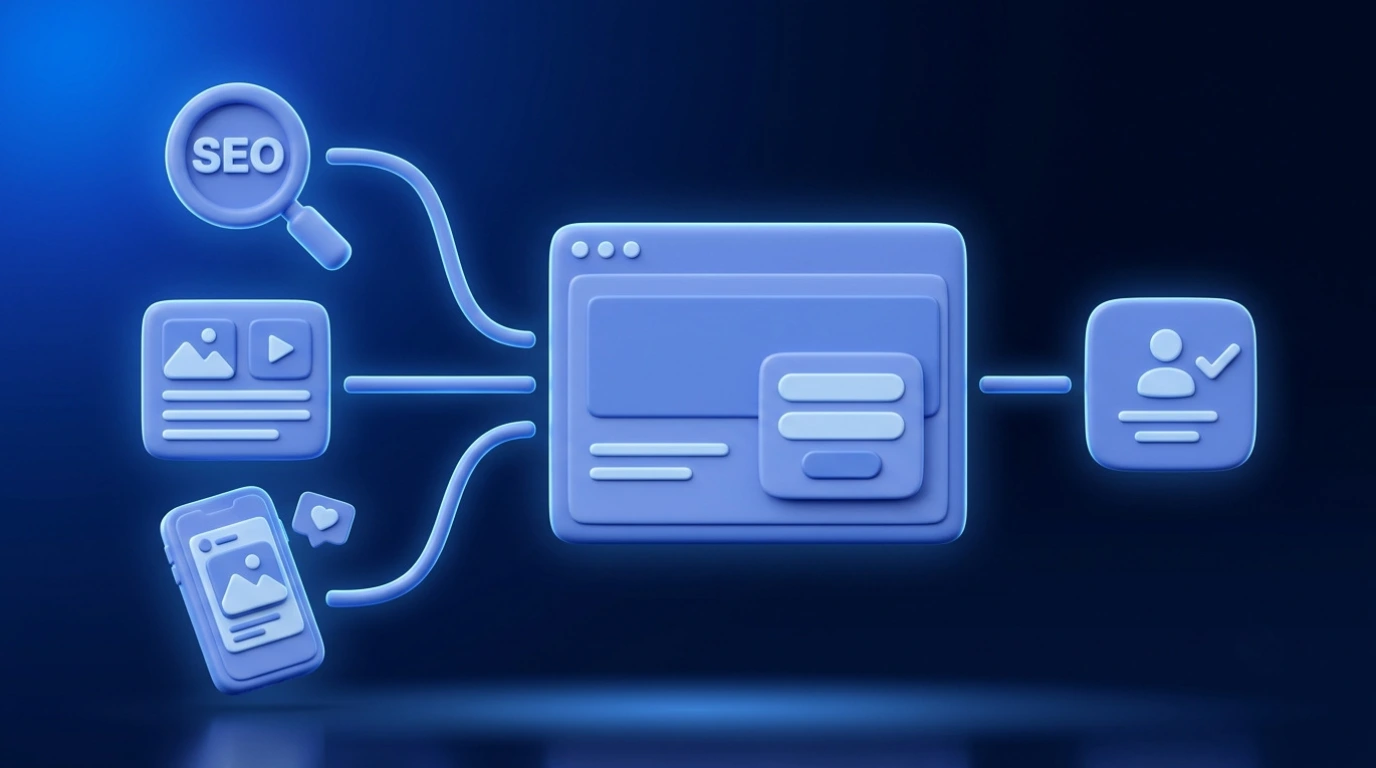
Advertisement → Relevant Landing Page → Clear Value Proposition → Proof → CTA
The fewer unnecessary decisions a prospect needs to make, the easier conversion becomes.
The Role of Performance Marketing
Performance Marketing can accelerate demand capture and customer acquisition by allowing businesses to target audiences and optimize campaigns based on measurable outcomes.
Different platforms can support different funnel stages.
Awareness campaigns
Introduce the brand to relevant audiences.
Consideration campaigns
Promote educational or solution-focused content.
Conversion campaigns
Promote products, services or offers to high-intent audiences.
Remarketing
Reconnect with people who previously interacted with the brand.
This creates a more structured advertising ecosystem than running the same advertisement to everyone.
Stage Five: Conversion Optimization
Driving traffic is only half the equation.
The other half is what happens after visitors arrive.
Conversion Optimization involves improving the percentage of visitors who complete the desired action.
Potential improvements include:
- Stronger headlines
- Better CTAs
- Clearer messaging
- Better page structure
- Faster loading
- Mobile optimization
- Better forms
- Stronger trust signals
- Simplified checkout
- Relevant landing pages
Small improvements can have significant commercial effects.
For example, increasing a landing page's conversion rate from 2% to 3% represents a 50% increase in conversions from the same amount of traffic.
This demonstrates why funnel optimization isn't always about acquiring more visitors.
Sometimes the opportunity is already on the website.
Stage Six: Retain Customers
The funnel doesn't end when someone purchases.
Acquiring a customer is often more expensive than maintaining an existing relationship.
Retention strategies may include:
- Email communication
- Customer education
- Loyalty programs
- Product recommendations
- Cross-selling
- Upselling
- Customer support
- Exclusive offers
- Community engagement
A satisfied customer can become more valuable over time.
Stage Seven: Turn Customers Into Advocates
The strongest customers can become brand advocates.
They may:
- Leave reviews
- Recommend the company
- Share content
- Refer friends
- Create user-generated content
- Make repeat purchases
Businesses should therefore create opportunities for satisfied customers to share their experiences.
A simple post-purchase review request can become an important part of the funnel.
Connecting the Funnel With Data
A full-funnel strategy requires measurement at every stage.
Awareness metrics
- Reach
- Impressions
- Search visibility
- Video views
- Brand searches
Consideration metrics
- Website engagement
- Content consumption
- Returning visitors
- Product views
- Landing-page activity
Conversion metrics
- Leads
- Purchases
- Conversion rate
- Customer acquisition cost
- Revenue
Retention metrics
- Repeat purchases
- Customer retention
- Lifetime value
- Renewal rate
Advocacy metrics
- Reviews
- Referrals
- User-generated content
- Referral conversions
The key is to connect these metrics rather than evaluating each stage independently.
How the Funnel Changes by Business Type
There isn't one universal funnel.
E-commerce
Discovery → Product Research → Product Page → Cart → Checkout → Purchase → Repeat Purchase
B2B
Awareness → Education → Lead → Qualification → Sales Opportunity → Proposal → Customer
Local Business
Discovery → Local Search → Website/Profile → Call/Visit → Purchase → Review
Professional Services
Awareness → Educational Content → Consultation → Proposal → Decision → Client
The underlying principles remain similar, but the customer journey differs.
A Practical Example
Consider a fictional SaaS company targeting small businesses.
Awareness
The company publishes educational content about improving business productivity.
Consideration
Visitors discover comparison guides and product explainers.
Engagement
They watch product videos and attend a webinar.
Conversion
Retargeting campaigns invite them to book a demo.
Sales
Qualified leads enter the CRM and receive personalized follow-up.
Retention
Customers receive onboarding content and product education.
Expansion
Existing customers are introduced to additional features.
Advocacy
Satisfied customers are invited to provide reviews and case studies.
The marketing strategy isn't a collection of disconnected campaigns.
It is one continuous journey.
Budget Allocation Across the Funnel
Budget allocation should reflect the business's current needs.
A new brand may need more investment in awareness.
An established brand with strong traffic but poor conversion may need greater investment in landing-page optimization and remarketing.
A business with strong acquisition but weak retention may need to prioritize customer lifecycle programs.
There is no universally correct percentage split.
The right allocation depends on:
- Business maturity
- Customer journey
- Industry
- Competition
- Average order value
- Sales cycle
- Existing demand
- Growth objectives
Why Full-Funnel Strategies Improve Marketing Efficiency
Without a connected funnel, businesses often repeat the same activities.
For example:
Marketing generates traffic.
Sales receives leads.
Nobody knows which leads are qualified.
The sales team struggles.
Marketing increases advertising.
Lead volume rises.
But revenue doesn't increase proportionally.
A connected funnel changes this.
Marketing can identify:
- Which audiences convert
- Which content influences decisions
- Which channels generate quality demand
- Where prospects drop off
- Which campaigns generate customers
- Which customers have higher value
This allows budgets to be allocated more intelligently.
Common Full-Funnel Mistakes
Focusing only on awareness
Visibility without a conversion pathway can create traffic without revenue.
Focusing only on conversions
Aggressive conversion campaigns may struggle when audiences don't yet trust the brand.
Ignoring retention
Customer acquisition isn't the end of the relationship.
Creating disconnected content
Content should support specific stages of the customer journey.
Sending every visitor to the same page
Different intent requires different landing experiences.
Measuring channels separately
Customers interact across multiple channels.
Ignoring sales feedback
Marketing performance improves when sales and marketing share information.
Building a Full-Funnel Strategy: Step-by-Step
Step 1: Define the commercial objective
Determine what the business needs to achieve.
Step 2: Identify the audience
Understand who the ideal customer is.
Step 3: Map the journey
Document how customers discover, research, evaluate and purchase.
Step 4: Identify customer questions
Understand what information prospects need at every stage.
Step 5: Assign channels
Determine which channels support each stage.
Step 6: Build content
Create resources aligned with customer intent.
Step 7: Create conversion pathways
Design landing pages and CTAs for specific actions.
Step 8: Connect analytics
Track users and conversions across the journey.
Step 9: Optimize
Improve weak stages based on evidence.
Step 10: Retain
Continue engaging customers after conversion.
Futuready Full-Funnel Audit Checklist™
Businesses can use the following checklist to evaluate their current marketing ecosystem.
Awareness
- Can customers easily discover the brand?
- Are we reaching relevant audiences?
Consideration
- Do we provide enough educational information?
- Can prospects compare and evaluate our solution?
Trust
- Do we demonstrate expertise?
- Do we have strong proof?
Conversion
- Are CTAs clear?
- Are landing pages relevant?
- Is the conversion process simple?
Retention
- Do we actively communicate with customers?
- Are repeat purchases encouraged?
Measurement
- Can we track the journey?
- Can marketing data be connected with sales and revenue?
If several answers are "no," there may be significant opportunities to improve the funnel without simply increasing advertising spend.
The Role of AI in Full-Funnel Marketing
AI can support nearly every stage of the funnel.
Awareness
Identify audiences and content opportunities.
Consideration
Personalize educational content.
Conversion
Analyze landing-page behaviour.
Retention
Identify customer patterns and create personalized communication.
Analytics
Detect trends and anomalies.
Content
Generate variations for different audiences and platforms.
But AI should operate within a clear strategy.
Technology can help businesses execute faster.
It doesn't determine what the business should ultimately stand for.
The Future of Full-Funnel Marketing
The traditional funnel is becoming less linear.
Customers may enter through social media, leave, return through search, interact with a video and then purchase after seeing a remarketing advertisement.
AI-powered search is also changing how people research products and services.
This means businesses need to think less about rigid stages and more about connected customer experiences.
The future-ready funnel will increasingly combine:
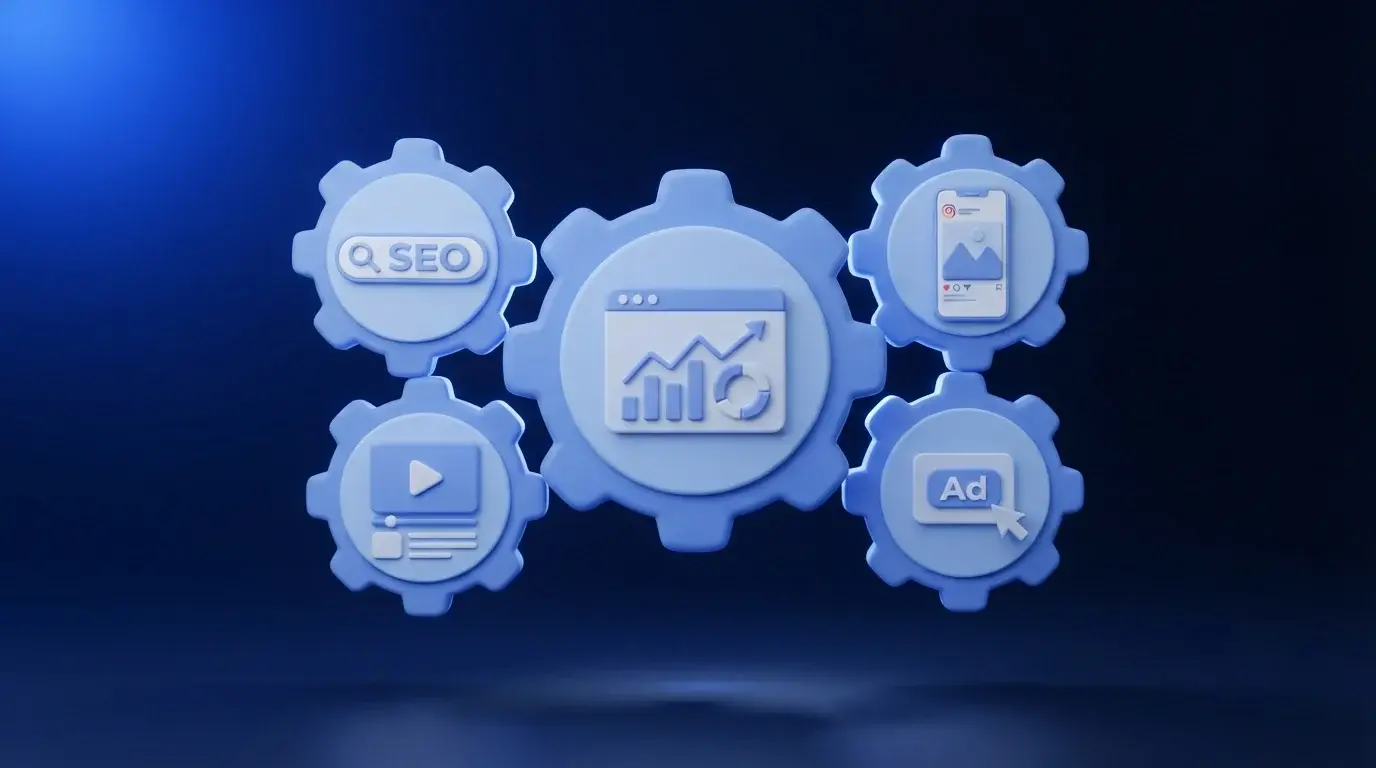
Search + Social + Content + Paid Media + Website + CRM + Analytics + AI
The strongest businesses won't necessarily have the most channels.
They will have the best connections between the channels they use.
Final Thoughts
Business growth rarely comes from one marketing activity.
It comes from creating a system in which every stage of the customer journey has a purpose.
Awareness creates discovery.
Education creates understanding.
Engagement builds familiarity.
Trust reduces uncertainty.
Conversion turns interest into revenue.
Retention increases customer value.
Advocacy creates additional growth.
That is the real value of a full-funnel approach.
Instead of asking whether SEO, social media, advertising or content is "working," businesses can ask a more important question:
Is the entire customer journey working?
When every stage is connected, marketing becomes easier to measure, easier to optimize and more closely aligned with business growth.
The objective isn't simply to generate more traffic or more leads.
It is to build a marketing system that consistently moves the right people from discovery to decision—and from first purchase to long-term customer value.
Commonly asked.
Honestly answered.
It is an integrated marketing approach that addresses the complete customer journey, from initial awareness and consideration through conversion, retention and advocacy.
It prevents businesses from focusing on only one stage of the customer journey and helps connect awareness, engagement, conversion and retention activities.
Depending on the business, channels can include search, social platforms, content, paid advertising, email, websites, remarketing, CRM and other customer communication channels.
No. E-commerce, B2B, local businesses and professional services have different customer journeys and therefore require different funnel structures.
Review performance across awareness, engagement, conversion and retention. A large amount of traffic with few conversions suggests a different issue from strong acquisition but weak repeat purchases.
Content can educate prospects, answer questions, demonstrate expertise, support evaluation and help customers make purchasing decisions.
Paid campaigns can support awareness, consideration, conversion and remarketing. The campaign objective and audience should determine the message and optimization approach.
The appropriate balance depends on business maturity, customer journey and commercial objectives. Both can play important roles at different stages.
Businesses can connect awareness, engagement, conversion, sales and retention data to understand how marketing contributes to the complete customer journey.
AI can support research, personalization, content production, analysis, audience insights and optimization. However, strategic decisions still require business context and human judgment.