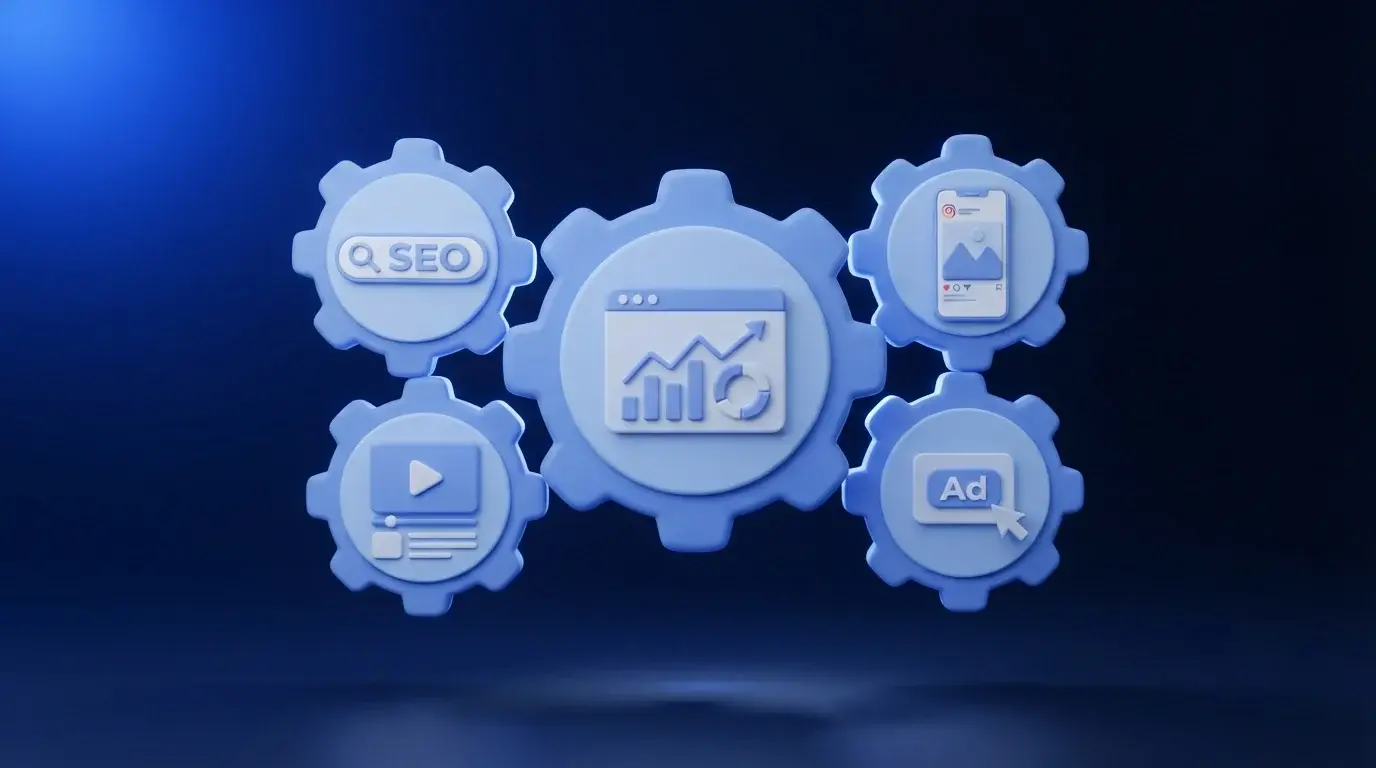
Online Visibility Strategies for Modern Businesses

A business can have an excellent product, competitive pricing and a capable team, yet struggle to grow if potential customers cannot find it.
Customer discovery has changed significantly.
People no longer rely on a single search engine or one website to research a business. They may discover a company through Google, see it on Instagram, watch a video on YouTube, read a LinkedIn post, check reviews, visit the website and even ask an AI platform for recommendations.
This means modern businesses need to think beyond simply "having a website."
They need to build a digital presence that is discoverable, recognizable, useful and credible across multiple customer touchpoints.
That is the foundation of a strong Online Visibility strategy.
The objective isn't to appear everywhere.
It is to appear in the right places, for the right audiences, at the right moments.
What Does Online Visibility Mean for a Business?
Visibility refers to how easily potential customers can discover and recognize a business across digital channels.
It can involve:
- Search results
- Social platforms
- Business listings
- Websites
- Blogs
- Video platforms
- Online communities
- Reviews
- Industry publications
- AI-powered search
- Digital advertising
However, visibility isn't simply about being present.
A customer needs to understand what the business does and why it matters.
For example, imagine someone discovers a company through a search result.
They visit the website and find unclear service descriptions.
Then they check social media and see inconsistent messaging.
Finally, they search for reviews but find very little information.
The business technically has a digital presence.
But its visibility ecosystem is weak.
Modern visibility requires presence plus clarity plus credibility.
Why Visibility Has Become More Competitive
Digital competition has expanded.
A business may now compete for customer attention against:
- Direct competitors
- Marketplaces
- Publishers
- Influencers
- Creators
- Review websites
- Social communities
- AI-generated answers
Customers also have more choices.
Before contacting a company, they can research alternatives within minutes.
This makes digital visibility particularly important for businesses operating in competitive markets.
The question is no longer:
"Do we have an online presence?"
It is:
"Can our target customers discover us, understand us and trust us online?"
The Futuready Modern Visibility Framework™
Futuready Media approaches digital visibility through six stages:
Position → Discover → Educate → Engage → Validate → Convert
Position
Define what the brand should be known for.
Discover
Make the brand easier to find through relevant digital channels.
Educate
Provide useful information that answers customer questions.
Engage
Create meaningful interactions across relevant platforms.
Validate
Build credibility through proof, reviews, expertise and third-party references.
Convert
Create clear pathways from digital discovery to business action.
This framework ensures visibility is connected to commercial outcomes.
1. Build a Strong Digital Foundation
Before investing heavily in traffic acquisition, businesses need a solid foundation.
This starts with the website.
A modern business website should clearly communicate:
Who you are
Explain the company and its positioning.
What you offer
Present products or services clearly.
Who you serve
Help visitors understand whether the business is relevant to them.
Why you are different
Explain meaningful advantages.
What customers should do next
Provide clear calls to action.
A website shouldn't force visitors to search for basic information.
Clarity is a visibility advantage because customers who understand a brand quickly are more likely to explore it further.
2. Build Search Visibility Around Customer Intent
Search remains one of the most important ways customers discover businesses.
SEO should therefore focus on more than ranking for high-volume terms.
The strategy should consider different types of intent.
Informational
The customer wants to learn.
Example:
How does website conversion optimization work?
Commercial
The customer is evaluating options.
Example:
Best website redesign agency
Transactional
The customer is ready to act.
Example:
Hire website redesign agency
Navigational
The customer is specifically looking for a brand.
Example:
Futuready Media
A strong search strategy creates content and landing pages for different stages.
3. Build Topical Authority
Search visibility becomes stronger when a business consistently demonstrates expertise around important subjects.
Instead of publishing unrelated articles, businesses can create topic clusters.
For example, a digital marketing company might develop interconnected resources around:
- Search marketing
- Paid advertising
- Social media
- Content
- Website development
- AI marketing
- Analytics
- Lead generation
Each topic can contain:
- Pillar pages
- Supporting articles
- FAQs
- Case studies
- Guides
- Videos
This creates a deeper information ecosystem.
The objective is to become associated with relevant topics rather than simply targeting individual search terms.
4. Use Social Media to Increase Brand Recognition
Social platforms offer a different visibility opportunity.
Search often captures people who already have a need.
Social platforms can introduce a brand before that need becomes urgent.
A customer might repeatedly encounter a company's:
- Industry insights
- Short videos
- Customer stories
- Product demonstrations
- Founder content
- Educational posts
Eventually, the brand becomes familiar.
That familiarity can influence future searches and purchasing decisions.
5. Create a Social Content System
A strong social presence requires more than frequent posting.
Content should have a purpose.
A practical mix could include:
Educational
Teach something useful.
Authority
Demonstrate expertise.
Proof
Show customer results and experiences.
Human
Show the people behind the company.
Product or service
Explain what the business provides.
Engagement
Encourage conversation.
Promotional
Communicate relevant offers and opportunities.
This creates a more balanced brand presence.
6. Turn Content Into a Visibility Asset
Content Marketing should not be treated as a publishing race.
The objective is to create useful assets that continue generating value.
Examples include:
- Blog articles
- Guides
- Case studies
- Videos
- Research
- Whitepapers
- Checklists
- Webinars
- Industry reports
- FAQs
The best content answers questions customers actually have.
It can then be repurposed across multiple channels.
For example:
One research report
can become:
- Blog article
- LinkedIn posts
- Video
- Infographic
- Email newsletter
- Webinar
- Sales presentation
This increases the return from content production.
7. Optimize Content for Answer-Based Discovery
Search is becoming increasingly conversational.
People don't always type short keywords.
They ask complete questions.
For example:
What should a small business consider before hiring a digital marketing agency?
This creates opportunities for answer-focused content.
AEO encourages businesses to make important information easy to identify and understand.
Useful formats include:
- FAQs
- Definitions
- Direct answers
- Step-by-step guides
- Comparison content
- Lists
- Explanations
The objective is to reduce the effort required for users to find the information they need.
8. Prepare for AI-Powered Discovery
AI platforms are changing how people research companies, products and services.
Instead of visiting several websites, users may ask an AI system to summarize options or explain what they should consider.
This introduces another visibility layer.
Businesses should ensure that their digital ecosystem clearly communicates:
- Brand identity
- Products
- Services
- Expertise
- Industry
- Location
- Target audience
- Differentiators
Information should also be consistent.
If the website says one thing while external sources contain outdated information, the overall brand picture becomes less clear.
9. Strengthen GEO Readiness
GEO focuses on visibility within generative search experiences.
Businesses can prepare by building a strong information ecosystem.
This includes:
- Comprehensive website content
- Clear service descriptions
- Expert resources
- Original insights
- Consistent brand information
- Relevant external references
- Structured information
- Strong topical authority
The objective isn't to create content specifically for machines.
It is to create a digital presence that is genuinely useful, credible and easy to understand.
10. Build Brand Authority Beyond Your Website
Your website is important, but it isn't the only source of information about your company.
Customers may evaluate:
- Reviews
- Business directories
- Social profiles
- Industry publications
- Interviews
- Podcasts
- Customer stories
- Community discussions
- Third-party articles
This makes external brand presence important.
A business becomes more credible when customers can find consistent information about it across multiple trusted environments.
11. Make Reviews Part of the Visibility Strategy
Reviews influence both discovery and decision-making.
Businesses should actively monitor relevant review platforms.
Encourage genuine customers to share their experiences.
Useful review strategies include:
- Asking customers after successful interactions
- Making the review process simple
- Responding professionally
- Addressing legitimate complaints
- Monitoring recurring feedback
Reviews shouldn't be treated as a separate reputation activity.
They are part of the customer's research process.
12. Use Video to Expand Reach
Video can create visibility across several platforms simultaneously.
Businesses can create videos around:
- Product demonstrations
- Customer questions
- Expert advice
- Tutorials
- Case studies
- Behind-the-scenes content
- Founder stories
- Industry trends
A single long-form video can be repurposed into multiple short-form pieces.
This makes video particularly useful for businesses trying to expand reach without creating completely new ideas for every platform.
13. Build Local Visibility
Businesses serving specific locations should prioritize local discovery.
A local customer may search for:
- Restaurants near me
- Digital marketing agency in Mumbai
- Salon near me
- Interior designer near me
- Hotel near me
- Clinic near me
Location-specific pages, accurate business information, reviews and relevant local content can help businesses become more discoverable in these searches.
Local visibility is particularly valuable because proximity often influences purchasing decisions.
14. Use Paid Advertising Strategically
Organic visibility takes time.
Paid advertising can accelerate exposure.
But advertising should complement the broader visibility strategy.
A business can use paid campaigns to:
- Launch new products
- Promote content
- Capture high-intent demand
- Retarget visitors
- Generate leads
- Drive sales
- Test messaging
Campaign data can also reveal which audiences and messages respond most strongly.
Those insights can inform organic content and broader marketing strategy.
15. Create a Cross-Channel Content Ecosystem
Modern customers move between platforms.
A strong visibility strategy should therefore create connections.
For example:
- Google Search
- Website Article
- LinkedIn Insight
- YouTube Video
- Case Study
- Consultation Page
Each channel reinforces the others.
This creates a stronger digital footprint than managing every platform independently.
16. Build a Brand Search Flywheel
A mature visibility strategy can create a powerful cycle.
- Useful Content
- Discovery
- Brand Recognition
- Branded Searches
- Website Visits
- Trust
- Conversions
- Reviews
- More Visibility
This is why businesses shouldn't judge every marketing activity only by immediate sales.
Some activities create demand that converts later.
17. Measure Visibility Correctly
Visibility requires more than one metric.
Businesses should consider several categories.
Search
- Organic impressions
- Relevant rankings
- Organic traffic
- Branded searches
- Search visibility
Social
- Reach
- Engagement
- Shares
- Video views
- Profile visits
Website
- Returning visitors
- Engagement
- Landing-page activity
- Conversions
Reputation
- Reviews
- Ratings
- Brand mentions
- Third-party references
Business outcomes
- Leads
- Sales
- Revenue
- Customer acquisition
- Repeat purchases
The ultimate objective is to connect visibility with business performance.
18. Don't Confuse Visibility With Popularity
A brand can have millions of impressions and still generate limited commercial value.
Likewise, a niche B2B company may have a relatively small audience but consistently attract highly qualified prospects.
The right question isn't:
"How many people saw us?"
It is:
"Did the right people discover us, understand us and take meaningful action?"
This distinction is particularly important for businesses with specialized audiences.
19. Create a 90-Day Visibility Plan
A practical implementation plan can make the strategy easier to execute.
Month 1: Foundation
- Audit website
- Review brand messaging
- Identify target audiences
- Analyze search demand
- Review social profiles
- Identify content gaps
- Check business listings and reviews
Month 2: Authority
- Publish cornerstone content
- Create supporting articles
- Develop social content
- Produce videos
- Strengthen internal linking
- Publish case studies
- Improve key service pages
Month 3: Distribution and Optimization
- Repurpose high-performing content
- Promote important resources
- Test paid campaigns
- Strengthen external visibility
- Monitor branded searches
- Review engagement
- Optimize underperforming pages
The objective is to create momentum rather than expecting immediate transformation.
20. Common Visibility Mistakes
Publishing without positioning
Content without a clear brand direction can create noise rather than recognition.
Trying to be everywhere
Businesses should prioritize platforms where their audience is relevant.
Focusing only on rankings
Search positions don't capture the entire customer journey.
Ignoring brand consistency
Different messaging across platforms can create confusion.
Creating content without distribution
Good content needs a path to discovery.
Ignoring reviews
Customers increasingly validate businesses before making decisions.
Treating AI as an afterthought
AI-driven discovery is becoming another part of the digital research process.
Measuring vanity metrics
Followers and impressions can be useful indicators, but business outcomes matter more.
Futuready Modern Visibility Checklist™
Before investing heavily in visibility campaigns, businesses can evaluate:
Brand
- Is our positioning clear?
- Do customers understand what we offer?
Website
- Are important products and services easy to find?
- Are our conversion paths clear?
Search
- Are we visible for relevant customer intent?
- Do we have strong topic coverage?
Social
- Are we consistently communicating our expertise?
- Are we building recognition?
Content
- Are we answering customer questions?
- Are we creating useful, reusable assets?
AI discovery
- Is our brand information consistent?
- Are we building authority around relevant topics?
Reputation
- Are customers finding credible reviews and references?
Measurement
- Can we connect visibility to leads, sales and revenue?
How an Agency Can Help
Building a modern visibility ecosystem requires expertise across multiple disciplines.
A specialized agency can help businesses:
- Research audiences
- Develop positioning
- Build content strategies
- Optimize websites
- Improve search visibility
- Manage social channels
- Develop paid campaigns
- Create video content
- Strengthen brand authority
- Analyze performance
- Adapt to AI-driven discovery
The value of an agency isn't simply the number of services it provides.
The value comes from how effectively those services work together.
A business should look for a partner capable of connecting strategy, execution and measurement.
The Future of Digital Visibility
The digital environment will continue to become more fragmented.
Search engines will evolve.
AI interfaces will become more common.
Social platforms will influence discovery.
Video will remain important.
Online communities will continue shaping opinions.
Customers will expect more information before making decisions.
This means businesses need to build portable digital authority.
A brand should not depend entirely on one search engine, one social platform or one advertising channel.
Instead, it should develop a presence that remains recognizable and credible across multiple environments.
Final Thoughts
Modern businesses need more than a website and a few social profiles.
They need a connected digital presence that allows customers to discover them, understand them, evaluate them and ultimately choose them.
That requires several elements working together:
Search Visibility + Content + Social Presence + Answer-Focused Information + AI Readiness + Reputation + Conversion
The objective isn't to chase every algorithm update.
It isn't to publish content simply for the sake of volume.
And it isn't to appear on every platform.
The objective is to build a digital ecosystem around the things customers actually care about.
When a customer searches for a problem, your brand should be discoverable.
When they research the solution, your content should be useful.
When they compare providers, your expertise should be visible.
When they validate the brand, your reputation should support the decision.
And when they are ready to act, the path should be clear.
That is what modern visibility should ultimately achieve:
Not just being seen, but being seen by the right people for the right reasons.
Commonly asked.
Honestly answered.
Start with a clear brand position, strong website foundation, useful content, search visibility, relevant social presence, credible reviews and consistent information across digital platforms.
The timeline depends on competition, industry, website authority, content quality, audience and marketing investment. Visibility generally grows through consistent activity rather than a single campaign.
Yes. Search remains a major discovery channel, especially when customers actively research products, services and solutions.
Yes. Consistent social content can increase exposure, build familiarity and encourage customers to search for and explore a brand.
Useful content creates opportunities to appear in search, answer customer questions, demonstrate expertise and distribute information across multiple platforms.
AI-powered platforms are becoming another way customers research and evaluate businesses. Clear, authoritative and consistent digital information can help a brand become more understandable within these environments.
No. Businesses should prioritize channels based on customer behaviour, business objectives, resources and expected commercial value.
Reviews can influence trust and purchasing decisions. They also provide potential customers with third-party perspectives beyond the company's own marketing.
Businesses can monitor search impressions, organic traffic, branded searches, social reach, engagement, website activity, reviews, mentions, leads and revenue.
One of the most common mistakes is treating visibility as a collection of independent activities rather than building a connected ecosystem where search, content, social, reputation and conversion support each other.