The Hidden Funnel Leak: Why Traffic Doesn't Convert Even After SEO, Ads and Social Efforts
You are spending on SEO. Running paid ads. Posting consistently on social media. Your traffic numbers look decent. But the leads are not coming in.
This is not a traffic problem. This is a funnel integrity problem.
Most brands treat their marketing channels as separate machines. SEO generates visitors. Ads drive clicks. Social builds awareness. But nobody is asking the more uncomfortable question: what happens after someone actually arrives? That gap between traffic and conversion is where most marketing budgets quietly bleed out. And the brands that diagnose it early are the ones that stop chasing more traffic and start working with a full-service digital marketing agency that builds systems that actually close.
Search traffic is some of the highest-intent traffic you can get. Someone typed a specific query, found your page, and clicked through. The motivation is there. So why are they leaving without doing anything?
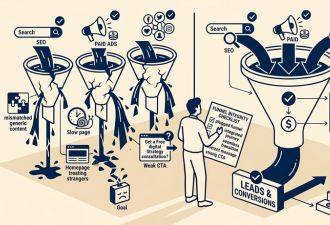
The answer almost always comes back to promise-to-page alignment. When the content they land on does not match the expectation set by the search result, the user exits within seconds. Your meta title promised a solution. Your page delivered a general overview. That mismatch is your first funnel leak.
The second issue is page structure. Most SEO content is written to satisfy crawlers, not buyers. It is long, detailed, and informative. But it never tells the visitor what to do next. No clear call to action. No transition from information to decision. The content educates and then abandons the reader at the exact moment they need direction.
A well-built digital strategy for lead generation does not just answer queries. It moves people from awareness to consideration within the same page.
PrintStop, an online printing solutions provider serving SMEs and large enterprises, was facing exactly this challenge. Strong product offering, established brand, but the website was creating friction at every step. Navigation was unclear. The ordering journey was broken. Visitors were arriving with intent but leaving without converting. When Futuready restructured their digital strategy and website experience, streamlining navigation and building a seamless ordering flow, the result was measurably increased traffic, clicks, and conversions. The product did not change. The funnel did.
The Paid Ads Illusion: Clicks That Go Nowhere
Paid campaigns get scrutinised at the wrong layer. Most performance reviews focus on CPM, CTR, and ROAS. Very few teams ask what happened on the landing page after the click.
Here is where money gets wasted. A well-optimised ad with sharp creative, tight targeting, and a relevant offer can still produce zero leads if the landing page experience is broken. Slow load time. Generic headline. A form with eight fields. No trust signals. No clarity on what happens after someone submits. The ad did its job. The page did not.
The other failure pattern is audience-to-message mismatch. Brands run retargeting campaigns to cold audiences and awareness campaigns to warm ones. The message is sent to the wrong person at the wrong stage of their journey. The click happens, but the conversion does not.
Performance marketing campaigns that drive results build the bridge between the ad and the action. The message, the creative, and the destination page are one coherent experience, not three independent moving parts.
Social Media Sends Warm Traffic Into Cold Pages
Social media builds context and affinity before anyone has visited your website. Someone has been watching your content, engaging with your brand, building a mental model of what you do. When they finally click through, they are arguably the warmest audience you have.
And then they land on a homepage built for strangers.
This is the social funnel leak almost nobody talks about. Social audiences arrive with a specific association in mind. If they found you through a post about brand storytelling, they expect that conversation to continue on your website. Instead, they get a generic services page that treats them like a first-time visitor.
The fix is not complex. Dedicated landing pages for social campaigns. Content that picks up where the post left off. A clear next step that matches what made them click in the first place.
Godrej Körber, a leader in automated intra-logistics solutions, needed their social presence to do more than generate impressions. The challenge was not awareness. It was translating that awareness into genuine brand authority and audience trust. Futuready built a full social media and content strategy for Godrej Körber that combined videos, blog content, and targeted social messaging, all consistently pointing back to a clear brand position. The result was stronger audience engagement, improved credibility, and a social presence that actually moved people rather than just reaching them.
Your Website Is Probably the Biggest Leak of All
SEO, ads, and social media are traffic mechanisms. But your website is where the conversion decision actually happens. If the site experience is broken, all three channels underperform simultaneously.
Speed issues kill intent before the page loads. Studies consistently show that even a two-second delay significantly drops conversion rates. Visitors do not wait.
Navigation is designed for the brand, not the buyer. When a visitor has to figure out where to go next, they leave. Your website should guide someone from arrival to action with minimal friction.
Social proof is missing in the right places. Testimonials buried in a footer. Case studies hidden behind a secondary menu. The evidence that builds trust needs to appear at the exact moment someone is considering whether to proceed.
Weak CTAs create hesitation instead of momentum. "Contact us" is not a call to action. It is a vague instruction. "Get a free digital strategy consultation" tells someone exactly what they are getting and reduces perceived commitment.
Brands that have addressed their channel performance but still see poor results are almost always dealing with a conversion issue at the site level. The traffic is real. The intent is there. Seeing how other brands handled this through real campaign work and case studies often shows what a functioning conversion layer actually looks like in practice.
The Real Problem Is That Nobody Owns the Full Funnel
SEO is owned by one person. Ads by another. Social by a third. And the website by either an IT team or no one in particular.
This is how funnel leaks survive for months and even years. Each channel shows its own metrics in isolation. SEO reports traffic. Ads report ROAS. Social reports reach. But the conversion rate across the entire journey never gets measured or owned by a single strategy.
The brands that fix this stop thinking in channels and start thinking in journeys. Every touchpoint is evaluated not just for what it delivers in isolation, but for how it hands off to the next stage.
Noida Power Company Limited serves over a million customers across Greater Noida. Despite that scale, their digital presence was fragmented. Customers were not being reached consistently, communication was unclear, and the brand lacked a unified digital voice. Futuready approached it as a full-funnel problem, not a content problem. By aligning corporate video production with social media creatives under a single coherent strategy, the result was a measurable improvement in customer transparency, engagement, and brand trust. One strategy. Multiple channels. One consistent experience.
Your branding investment means nothing if the landing page it points to does not continue the story. Your SEO work is wasted if the page experience does not convert the intent you worked to earn. And your social presence is an untapped conversion asset if the destination pages treat your audience like strangers.
Plugging funnel leaks is not glamorous work. But it consistently produces more return than any new channel, increased spend, or campaign refresh. Fix what is already broken before building more on top of it.
Commonly asked.
Honestly answered.
Traffic without conversion usually means a breakdown between the visitor's expectation and what your page delivers. This could be a mismatch in messaging, weak call-to-action placement, slow page speed, or a lack of trust-building elements at the right stage of the page. Getting traffic is only half the equation.
Start with bounce rate and scroll depth data. If visitors are landing and leaving quickly without scrolling, your above-the-fold experience is failing. Pair that with heatmap tools like Hotjar to see exactly where attention drops. Session recordings often reveal friction you would never notice manually.
No. Increasing ad spend on broken landing pages accelerates losses, not results. More traffic into a leaky funnel means more waste. Fix the conversion layer first, then scale ad spend once you have a proven cost-per-acquisition that makes commercial sense.
Trust signals at decision points. Most B2B buyers do not convert on the first visit. They research, compare, and return. When they do come back, they need to see proof: client names, measurable outcomes, case examples, and a clear explanation of the process after they reach out. These elements reduce the perceived risk of taking action.
Social warms up your audience before they visit. When your website experience does not match the tone, style, or context of your social content, there is a disconnect that erodes the trust you built. Branded consistency between your social voice and your website experience directly affects conversion rates, especially for returning visitors.
SEO traffic tends to carry higher mid-to-bottom-funnel intent because users are actively searching for a solution. Paid traffic can capture any stage of the funnel depending on targeting. Both require landing page alignment to convert, but SEO traffic typically needs less persuasion and more structure, while paid traffic often needs stronger creative and a more direct offer.
It depends on your current capability and speed requirement. In-house teams often have deep product knowledge but lack conversion-specific expertise and bandwidth. A specialist agency brings pattern recognition across many funnels and can identify and fix leaks significantly faster. The decision should be driven by how much revenue the leak is currently costing you per month.