How AI Content Creation Services Help Businesses Scale Marketing
Marketing today demands more content than ever before. Businesses are expected to maintain an active presence across websites, blogs, social media, email campaigns, video platforms, search engines, and AI-powered search experiences. Customers want valuable information before making a purchase, and search engines reward brands that consistently publish high-quality, relevant content.
For many businesses, this creates a difficult challenge. The demand for content keeps growing, but internal marketing teams often struggle with limited time, resources, and budgets. Creating one well-researched blog, a series of social media posts, an email campaign, product descriptions, and ad copy can consume days—or even weeks. By the time one campaign is complete, another is already waiting.
This is where AI content creation services are transforming modern marketing.
Contrary to popular belief, AI content isn't about replacing human creativity with automation. It's about helping businesses create smarter content, publish faster, maintain consistency, and scale marketing efforts without compromising quality. When combined with strategic planning, SEO expertise, and human editing, AI becomes one of the most powerful tools for accelerating business growth.
The companies that are gaining a competitive advantage today are not necessarily producing the most content. They are producing the right content, for the right audience, at the right time, using AI to remove bottlenecks while allowing marketers to focus on strategy and creativity.
The Content Scaling Challenge Every Business Faces
Content marketing has evolved far beyond publishing an occasional blog or sharing promotional posts on social media.
Today's customer journey involves multiple touchpoints before someone decides to contact a business. A potential customer might discover your company through a Google search, read several blog articles, watch videos on social media, download a guide, subscribe to your email newsletter, and compare your services before finally requesting a consultation.
Every one of these interactions requires high-quality content.
For businesses trying to grow, this creates several common challenges:
- Limited in-house content teams
- Rising costs of hiring writers and designers
- Increasing competition in organic search
- The need to publish consistently across multiple platforms
- Keeping content updated with changing industry trends
- Maintaining a consistent brand voice
Many marketing teams eventually reach a point where content production becomes the biggest bottleneck to growth. They know content generates traffic and leads, but they simply cannot produce enough of it consistently.
Scaling marketing isn't just about increasing advertising budgets. It's about increasing your ability to communicate with your audience through valuable, relevant, and engaging content.
Why Traditional Content Production Doesn't Scale
Traditional content creation is often a slow, fragmented process.
A single blog article may involve keyword research, competitor analysis, outlining, writing, editing, SEO optimization, image creation, internal linking, proofreading, publishing, and promotion. Multiply this process across dozens of blogs, landing pages, email campaigns, and social media posts, and it's easy to see why marketing teams become overwhelmed.
The problem becomes even more significant when businesses expand into multiple channels.
Today's marketing requires content for:
- SEO blogs
- Website pages
- Landing pages
- Google Ads
- Meta Ads
- LinkedIn posts
- Instagram content
- Email newsletters
- Video scripts
- Case studies
- Whitepapers
- Product descriptions
- AI search optimization
Managing all these formats manually slows execution and delays campaigns.
Speed has become a competitive advantage. Brands that publish consistently often dominate search visibility, build stronger authority, and stay top-of-mind with potential customers.
Businesses relying solely on traditional workflows frequently struggle to keep pace.
What AI Content Creation Services Actually Include
One of the biggest misconceptions surrounding AI content is that it's simply about asking an AI tool to write a blog article.
Professional AI content creation services go far beyond automated writing.
They combine artificial intelligence with marketing strategy, SEO expertise, brand messaging, audience research, and editorial quality control to create content that supports measurable business objectives.
A comprehensive AI content solution typically includes:
SEO Blog Content
Long-form articles designed to improve organic rankings, answer customer questions, and establish topical authority.
Website Copy
Clear, persuasive website content that communicates value propositions while improving user experience and search visibility.
Landing Pages
Conversion-focused landing pages that align messaging with advertising campaigns and encourage visitors to take action.
AI Copywriting Services
Compelling copy for advertisements, email campaigns, product descriptions, sales pages, and promotional campaigns.
Social Media Content
Platform-specific content that increases engagement while maintaining consistent brand messaging.
Video Scripts
Scripts for explainer videos, corporate films, product demonstrations, YouTube videos, and social media reels.
Content Repurposing
Transforming one long-form article into multiple social media posts, newsletters, infographics, short videos, and email sequences.
Instead of creating every asset independently, AI helps businesses maximize the value of every content investment.
AI Doesn't Replace Marketing Teams—It Makes Them More Effective
The discussion around AI often focuses on replacement.
In reality, the biggest advantage of AI lies in augmentation.
Successful businesses are not replacing marketers with AI. They're empowering marketers to work faster and make better strategic decisions.
Consider the traditional workflow of creating a blog article.
Without AI, marketers spend hours researching competitors, identifying keywords, organizing ideas, drafting outlines, refining structure, checking grammar, and optimizing content.
With AI assisting these repetitive tasks, marketers can devote significantly more time to:
- Developing stronger messaging
- Understanding customer pain points
- Creating compelling storytelling
- Improving conversion rates
- Building thought leadership
- Refining brand positioning
- Measuring campaign performance
Rather than eliminating creativity, AI allows creativity to focus where it delivers the greatest business value.
The Biggest Misconception About AI Content
Perhaps the most dangerous assumption businesses make is believing AI automatically creates great marketing content.
It doesn't.
AI can generate text remarkably quickly, but speed alone doesn't create trust.
Content that performs well in search engines and converts readers into customers requires several elements that AI cannot fully understand on its own:
- Business strategy
- Customer psychology
- Brand positioning
- Industry expertise
- Competitive differentiation
- Buyer intent
- Emotional persuasion
Without these ingredients, AI-generated content often sounds generic.
Readers can quickly recognize articles that simply repeat information already available elsewhere online.
Search engines—and increasingly AI-powered search platforms—are rewarding content that demonstrates real expertise, unique perspectives, and practical experience.
The future of content marketing belongs to businesses that combine AI efficiency with human insight.
From Content Production to Content Strategy
Publishing more content doesn't automatically produce better marketing results.
Many businesses have hundreds of blog posts attracting traffic but generating very few qualified leads.
The difference lies in strategy.
Effective AI content marketing isn't about producing content for its own sake. It's about building a connected ecosystem where every piece of content serves a specific purpose within the buyer journey.
A blog article educates potential customers.
That article links to a relevant service page.
The service page encourages readers to download a guide or book a consultation.
An email sequence nurtures those leads with additional insights.
Short-form videos reinforce key messages on social media.
Case studies provide credibility before the buying decision.
Each content asset supports the next, creating a continuous journey from awareness to consideration and ultimately to conversion.
Businesses that approach AI content this way aren't simply creating more content—they're building scalable marketing systems.
How AI Content Marketing Creates a Compounding Growth Engine
One of the biggest advantages of investing in AI Content Creation Services is that the results compound over time. Unlike paid advertising, where visibility often disappears the moment the campaign budget stops, quality content continues to attract traffic, generate leads, and build authority long after it has been published.
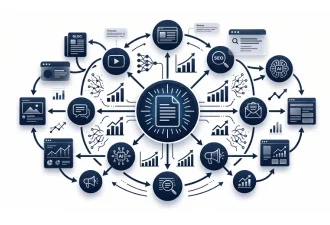
Think of content as a connected ecosystem rather than a collection of isolated assets.
A well-researched blog article can rank in search results, answer a buyer's questions, and establish your expertise. That same article can be repurposed into LinkedIn posts, Instagram carousels, email newsletters, short-form videos, and downloadable resources. Instead of creating fresh content from scratch every time, AI helps marketers extend the lifespan of each content asset while maintaining consistency across channels.
This is where AI content marketing delivers its greatest value. Rather than accelerating content production alone, it enables businesses to build an interconnected marketing system where every asset supports the next stage of the customer journey.
For example, a business searching for "AI Content Creation Services" might first discover your blog through Google Search or an AI-powered search engine. After reading the article, they may explore your service page, download a guide, subscribe to your newsletter, and later see a remarketing advertisement highlighting a relevant case study. By the time they contact your sales team, they already understand your expertise and trust your brand.
Each interaction reinforces the previous one. The result is stronger brand recall, higher-quality leads, and shorter sales cycles.
This compounding effect is why businesses investing in content consistently outperform competitors relying solely on paid campaigns.
Where Businesses See the Biggest ROI from AI Content Creation Services
Although nearly every industry benefits from scalable content marketing, some sectors are seeing particularly strong returns from AI-assisted content strategies.
Healthcare
Healthcare providers need to educate patients while building trust. AI helps create informative articles, treatment guides, FAQs, email campaigns, and awareness content at scale, while medical experts ensure factual accuracy and compliance.
Education
Educational institutions compete for student attention across search engines, social media, and digital advertising. AI enables universities, colleges, coaching centres, and edtech platforms to consistently publish admission guides, career resources, program pages, student success stories, and SEO-focused blogs that improve visibility and support enrolment campaigns.
Real Estate
Property developers and real estate consultants require content for project launches, location guides, investment insights, landing pages, neighbourhood comparisons, and video scripts. AI speeds up production while allowing marketing teams to focus on campaign strategy and lead nurturing.
E-commerce
Online retailers manage hundreds or even thousands of products. AI significantly reduces the time required to create product descriptions, category pages, buying guides, promotional emails, and SEO content, improving both discoverability and customer experience.
SaaS and Technology
Software companies often need to explain complex products in simple language. AI helps generate knowledge base articles, feature pages, customer onboarding content, webinars, whitepapers, and thought leadership that educate prospects throughout the buying journey.
Across industries, the common advantage remains the same: businesses can create more valuable content without proportionally increasing marketing costs.
The Human + AI Formula That Delivers Better Marketing Results
One misconception businesses often have is that purchasing an AI tool automatically gives them a competitive advantage.
Technology alone rarely creates differentiation.
The businesses achieving exceptional results combine AI with experienced marketers who understand strategy, customer behaviour, and brand positioning.
The most effective content creation process typically follows this model:
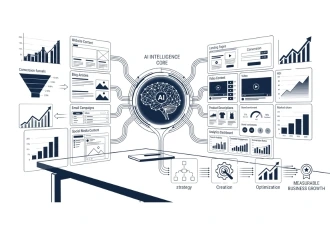
Business Objectives → Audience Research → AI-Assisted Ideation → SEO Strategy → Human Writing & Editing → Brand Review → Publishing → Performance Analysis → Continuous Optimisation
AI accelerates research, outlines, first drafts, repurposing, and optimisation.
Humans contribute the insight that AI cannot replicate:
- Understanding customer pain points.
- Building emotional connections.
- Creating persuasive messaging.
- Aligning content with business goals.
- Developing original perspectives.
- Maintaining brand voice.
- Identifying opportunities competitors overlook.
This combination produces content that is both scalable and genuinely valuable.
Businesses looking for long-term growth should avoid viewing AI as a shortcut. Instead, it should be treated as a strategic partner that enhances the capabilities of experienced marketing professionals.
How to Choose the Right AI Content Creation Partner
As AI becomes more accessible, many agencies now claim to offer AI-powered content services. However, not every provider delivers the same level of quality or strategic thinking.
When evaluating an AI content creation partner, consider these questions:
- Do they begin with business strategy? Content should support commercial objectives rather than simply increase publishing frequency.
- Do they understand SEO? Great content must be discoverable. Keyword research, topical authority, semantic optimisation, and internal linking remain essential.
- Can they maintain your brand voice? Your content should sound like your business—not like generic AI-generated text.
- Do they combine AI with human expertise? Human editing, fact-checking, and strategic input are critical for producing content that builds credibility.
- Can they create a complete content ecosystem? Look beyond blogs. Your partner should be able to support website copy, landing pages, email campaigns, ad copy, social media content, and video scripts as part of an integrated strategy.
The right agency doesn't simply deliver articles—it helps build a marketing engine that supports long-term growth.
The Future of AI Content Marketing
The way people search for information is changing rapidly.
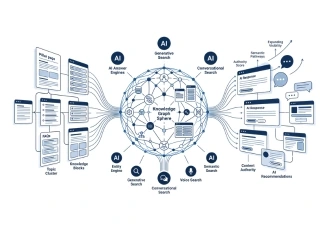
Traditional search engines are increasingly integrating AI-generated answers, while users are turning to conversational AI platforms to research products, compare services, and evaluate providers.
This shift means businesses need to create content that is not only optimised for search engines but also for AI-powered discovery.
Modern content strategies increasingly focus on:
- Building topical authority rather than targeting isolated keywords.
- Answering real customer questions with depth and clarity.
- Structuring content for featured snippets and AI-generated summaries.
- Demonstrating expertise through original insights and practical examples.
- Publishing interconnected content that supports the entire buyer journey.
As AI Overviews, conversational search, and answer engines become more influential, businesses with comprehensive, authoritative content libraries will gain a significant competitive advantage.
Rather than replacing SEO, AI is reshaping it. Brands that combine SEO, GEO (Generative Engine Optimisation), AEO (Answer Engine Optimisation), and high-quality content creation will be better positioned to remain visible wherever potential customers search for answers.
Marketing at Scale Requires More Than Automation
The future of marketing doesn't belong to businesses producing the highest volume of content. It belongs to businesses producing the most relevant, helpful, and strategically aligned content.
By reducing repetitive tasks, accelerating research, and improving production efficiency, AI enables marketing teams to focus on what truly drives business growth—understanding customers, solving problems, building trust, and creating memorable brand experiences.
However, technology alone is never the competitive advantage.
The real advantage comes from combining AI with strategy, creativity, SEO expertise, and human insight to build a connected content ecosystem that attracts qualified traffic, nurtures prospects, and converts interest into revenue.
Businesses that embrace this approach won't simply publish more content. They'll create smarter marketing systems that continue generating value long after each piece of content goes live.
As customer expectations continue to evolve and digital competition intensifies, scalable content marketing will become one of the defining characteristics of successful businesses. AI is not replacing marketers—it is empowering them to build faster, think bigger, and deliver more meaningful experiences at every stage of the buyer journey.
Commonly asked.
Honestly answered.
AI Content Creation Services combine artificial intelligence with human expertise to produce blogs, website copy, social media content, email campaigns, landing pages, ad copy, video scripts, and other marketing assets more efficiently while maintaining quality and strategic alignment.
Yes, when created strategically. AI-assisted content that is reviewed, optimised, and enhanced by SEO professionals can perform well in search results. The key is ensuring originality, topical authority, user value, and alignment with Google's quality guidelines.
No. AI accelerates research, drafting, and optimisation, but human expertise remains essential for strategy, storytelling, brand voice, emotional connection, and creating content that genuinely resonates with audiences.
Industries such as healthcare, education, real estate, e-commerce, SaaS, finance, hospitality, manufacturing, and professional services benefit significantly because they require consistent, high-quality content across multiple marketing channels.
AI reduces the time required for research, drafting, editing, and repurposing content, allowing businesses to publish more consistently across blogs, websites, social media, email campaigns, and advertising while maintaining quality and improving marketing efficiency.
No. The most effective approach combines AI technology with experienced marketers, SEO specialists, editors, and strategists. This ensures content remains accurate, engaging, brand-consistent, and commercially effective.
AI copywriting services enable businesses to create high-performing landing pages, advertisements, emails, and website copy more efficiently, reducing production costs while increasing opportunities to generate qualified leads and improve conversion rates.
AI tools generate content, but agencies combine those tools with market research, SEO strategy, brand positioning, audience understanding, human editing, and performance optimization. The result is content that supports measurable business growth rather than simply increasing publishing volume.