How AI Search (ChatGPT, Gemini) Is Replacing Google and What Businesses Must Do Now
Something significant is happening to the way people search for information online.
For nearly three decades, Google was the undisputed starting point for every question, every product comparison, every service lookup. You typed a query, you got ten blue links, and you clicked through to find your answer.
That behavior is changing faster than most businesses realize.
Today, a growing number of people are skipping Google entirely and going straight to ChatGPT, Gemini, or Perplexity for answers. And when they do, they are not getting ten links to scroll through. They are getting a single, direct answer generated by AI. If your brand is not part of that answer, you simply do not exist at that moment. Understanding how to respond to this shift starts with knowing what AI-powered digital marketing actually looks like in practice.
What Is AI Search and Why Is It Different From Google?
AI search refers to platforms like ChatGPT Search, Google's AI Overviews, Gemini, and Perplexity that use large language models to generate direct answers to user queries rather than returning a list of links.
The difference is fundamental.
Traditional Google search returns options. AI search returns conclusions.
When someone asks Google "best digital marketing agency in Mumbai," they see a list of results they then evaluate themselves. When they ask ChatGPT or Gemini the same question, they receive a synthesized answer that already points them toward specific choices. The evaluation has already happened before the user clicks anything.
For businesses, this changes everything about how visibility works online.
How Fast Is This Shift Actually Happening?
The numbers are difficult to ignore. ChatGPT crossed 100 million users faster than any platform in history. Google responded by rolling out AI Overviews globally, effectively placing an AI-generated answer above all organic search results for millions of queries. Perplexity has positioned itself as an "answer engine" and is growing rapidly among professionals and researchers. Microsoft integrated AI search into Bing through Copilot. Apple is rumored to be exploring AI-powered search features across its devices. The direction is unmistakable. This does not mean Google is dying tomorrow. It is still the dominant search platform globally. But the share of queries being answered directly by AI, without a click to any website, is growing every month. And for businesses that have built their entire digital visibility strategy around organic Google rankings, this trend represents a genuine risk that cannot be ignored.
What This Means for Your Business Visibility
Here is the core problem for most businesses. Traditional SEO was built around getting your website to rank in position one, two, or three on Google. Traffic flowed from those rankings to your website where conversions happened. AI search compresses that journey. The AI reads thousands of sources, synthesizes an answer, and presents it directly. Your website may have contributed to that answer without ever receiving a visit. Or your website may not have been considered at all. Businesses that are not optimizing for AI search are already losing visibility they cannot see in their analytics because the lost traffic never existed to measure. The user found an answer and moved on without ever visiting any website. This is why Generative Engine Optimization (GEO) and Answer Engine Optimization (AEO) have become critical disciplines for any business serious about digital visibility in 2025 and beyond.
What Is GEO and AEO and Why Do They Matter?
Generative Engine Optimization is the practice of structuring your content, brand authority, and digital presence so that AI platforms are more likely to reference, cite, or recommend your brand when generating answers.
Answer Engine Optimization is the broader practice of ensuring your content directly and clearly answers the specific questions your audience is asking, in a format that both AI engines and traditional search features like Featured Snippets and People Also Ask can easily extract and use.
Both disciplines share the same foundation: your content must be authoritative, well-structured, factually clear, and genuinely useful. The difference is that GEO and AEO optimize specifically for how AI models evaluate and select content when building their responses.
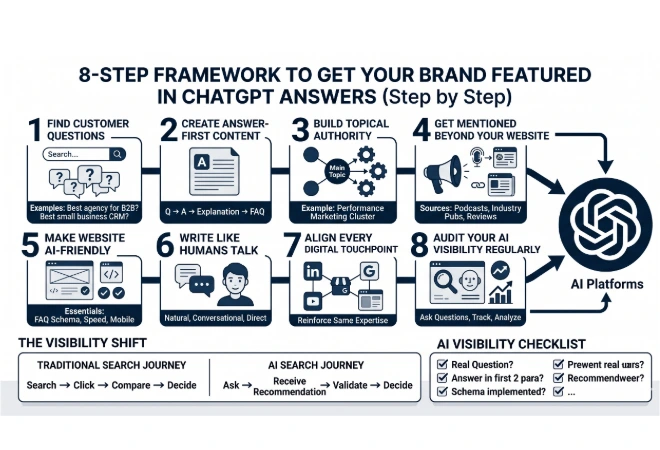
5 Things Businesses Must Do Right Now
1. Optimize for Questions, Not Just Keywords
AI search is conversational. People ask complete questions rather than typing fragmented search terms. Your content must answer real, specific questions your audience is asking in natural language.
Every blog, service page, and FAQ section should be built around the actual questions your potential customers type into ChatGPT or Gemini. If your content only targets short-tail keywords and does not directly answer questions, it is invisible to AI search engines.
2. Build Genuine Topical Authority
AI platforms do not just pull from any website. They reference sources that demonstrate consistent, deep expertise on a specific topic area.
A brand that has published twenty well-researched articles on digital marketing, conversion optimization, and SEO strategy is far more likely to be cited in an AI-generated answer than a brand with three generic service pages. Building topical authority through consistent, high-quality content is no longer just an SEO strategy. It is an AI visibility strategy.
3. Structure Your Content for Direct Answers
AI models look for content that answers questions concisely and clearly. Use short, direct paragraphs. Use definition-based sections. Use numbered lists and clear subheadings that signal the structure of your content to both AI crawlers and human readers.
If your content buries the answer in long paragraphs of context, AI platforms will find a source that gets to the point faster. Structure is no longer just a readability preference. It is a ranking signal for AI search.
4. Earn Brand Mentions Across the Web
AI platforms are trained on the broader web. The more your brand name, expertise, and unique perspectives appear across authoritative sources including news sites, industry publications, podcasts, and guest articles, the more likely an AI model is to recognize your brand as a credible reference.
Backlinks built your authority on Google. Brand mentions and citations across the web build your authority on AI platforms. The two strategies overlap significantly but the emphasis shifts.
5. Do Not Abandon Google SEO
This is the most important nuance of the entire conversation.
Google AI Overviews are still powered by Google's index. The content that appears in AI Overviews is almost always content that already ranks well in traditional organic search. Strong technical SEO, quality content, and genuine backlink authority are still the foundations everything else is built on.
The brands that will win the AI search era are not the ones that abandoned SEO for something new. They are the ones that built on their existing SEO strength and extended it into GEO and AEO disciplines simultaneously.
How Futuready Media Approaches AI Search Optimization
At Futuready Media, we have been building AI search visibility strategies for brands alongside traditional SEO and performance marketing for some time.
Our approach combines content architecture designed for AI answer extraction, topical authority building through consistent publishing, structured data implementation to help AI platforms understand your content, and brand citation strategies that extend your visibility beyond your own website.
The goal is not to chase the latest trend. It is to ensure that wherever your audience goes to find answers, whether that is Google, ChatGPT, Gemini, or Perplexity, your brand is part of the conversation.
Explore our full digital strategy approach to understand how we build this kind of presence for brands across industries.
Quick Takeaway
AI search is not replacing Google overnight. But it is changing where answers come from and how brands earn visibility. The businesses that start optimizing for AI search today will have a significant head start over those who wait until the shift is undeniable. The strategies that work are not entirely new. They are an evolution of what good SEO and content marketing have always demanded: genuine expertise, clear structure, and consistent authority.
Conclusion
The rise of ChatGPT, Gemini, and AI-powered search is not a threat to businesses that are willing to adapt. It is an opportunity for brands that build their digital presence correctly to earn a level of visibility that was simply not possible in the traditional ten-blue-links model of search.
The fundamentals have not changed. Expertise, authority, trust, and clear answers have always been the currency of digital visibility. AI search has simply raised the stakes for brands that deliver on those fundamentals and exposed those that never did.
The question is not whether AI search is replacing Google. The question is whether your brand is visible wherever your customers are looking for answers right now.
If you want to build that visibility the right way, get in touch with our team and let us map out the right strategy for your business.
Commonly asked.
Honestly answered.
AI search is not replacing Google entirely but it is fundamentally changing how a growing number of queries are answered. Google itself has integrated AI through AI Overviews. Platforms like ChatGPT, Gemini, and Perplexity are handling millions of queries daily that previously would have gone to traditional search. Businesses need to optimize for both traditional SEO and AI search simultaneously to maintain full visibility.
Answer Engine Optimization is the practice of structuring your content to directly answer the specific questions your audience is asking, in a format that AI platforms and search engines can easily extract and use when generating responses. It focuses on clear, concise, factually accurate answers presented with logical structure rather than keyword-optimized content built purely for ranking.
Generative Engine Optimization is the practice of building your brand's content authority and digital presence so that AI platforms like ChatGPT, Gemini, and Perplexity are more likely to reference or recommend your brand when generating answers to relevant queries. It extends traditional SEO principles into the emerging landscape of AI-powered search.
To improve your chances of appearing in AI-generated answers, focus on building genuine topical authority through consistent, high-quality content publishing, structuring your content to answer questions directly and clearly, earning brand mentions across authoritative external sources, implementing structured data on your website, and maintaining strong technical SEO foundations that signal credibility to both traditional and AI-powered search systems.
Yes. SEO remains the foundation of AI search visibility. Google's AI Overviews pull primarily from content that already ranks well organically. ChatGPT and other AI platforms are trained on web content and prioritize sources with demonstrated authority. Strong SEO, quality content, and credible backlinks are still the most important signals for visibility across both traditional and AI-powered search platforms.
The time to adapt is now. AI search adoption is growing rapidly and the brands building authority and optimizing for AI visibility today will have a significant head start. The strategies required, including topical authority building and question-focused content, take time to compound. Waiting until AI search becomes dominant means starting from scratch when competitors have already built months or years of momentum.