How to Get Your Brand Featured in ChatGPT Answers (Step by Step)
Imagine a potential customer opens ChatGPT and types a question your brand should be answering.
Something like "What is the best digital marketing agency in Mumbai?" or "Which software tool should I use for project management?" or "Where should I buy premium yoga mats in India?"
ChatGPT generates a response. It names specific brands. It explains why they are credible.
Is your brand one of them?
For most businesses, the honest answer is no. And the reason is not that their product or service is inferior. It is that they have never deliberately built the kind of digital presence that AI platforms use to decide which brands deserve to be in the answer. Understanding how to fix that starts with knowing how AI-powered digital marketing actually works in 2025 and what it takes to show up where your audience is looking.
This is a practical, step-by-step guide to getting your brand featured in ChatGPT answers. No theory. No vague advice. Just the specific actions that move the needle.
First, Understand How ChatGPT Decides What to Recommend
Before you can optimize for ChatGPT, you need to understand how it makes decisions.
ChatGPT is trained on a massive dataset of web content. It learns which brands, sources, and experts are consistently referenced, cited, and recommended across the internet. When a user asks a question, ChatGPT synthesizes what it has learned and generates a response based on patterns of credibility, relevance, and consistency.
This means ChatGPT does not browse your website in real time and decide whether to recommend you. It draws on everything it has already absorbed during training, and increasingly through its live web search feature, which looks for sources that are authoritative, well-structured, and factually clear.
The brands that get featured are the ones that show up consistently across multiple credible touchpoints. The ones that answer questions clearly. The ones that have earned recognition beyond their own website.
That is the foundation every step in this guide is built on.
Step 1: Identify the Exact Questions Your Audience Asks ChatGPT
This is where everything starts.
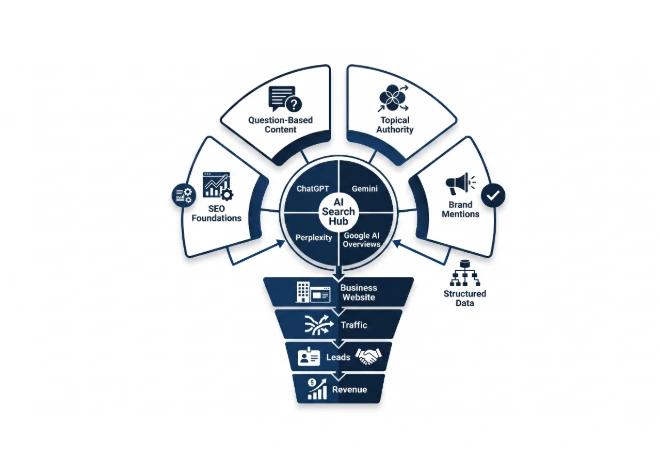
Most businesses optimize for keywords. Getting featured in ChatGPT requires optimizing for questions. Real, conversational, specific questions that your ideal customer is typing into an AI platform right now.
Start by brainstorming every question a potential customer might ask about your category, your service, your product, or the problem you solve. Think in natural sentences, not search terms.
Not "digital marketing Mumbai" but "Which digital marketing agency in Mumbai is best for a B2B company?"
Not "yoga mats India" but "What type of yoga mat should I buy for hot yoga?"
Not "project management software" but "What is the best project management tool for a remote team of ten people?"
Go deeper. Think about comparison questions, decision-making questions, and problem-based questions. These are the formats that generate AI answers, and they are the questions your content must directly and confidently answer.
Write down at least twenty to thirty of these questions. They become the editorial backbone of your entire GEO strategy.
Step 2: Build Content That Answers Questions Directly and Completely
Once you have your question list, the next step is creating content that answers each one better than anything else currently available on the internet.
This is non-negotiable. ChatGPT does not feature brands that sort of answer questions. It features brands that answer them with clarity, depth, and genuine usefulness.
Here is what that looks like in practice.
Every piece of content should answer the target question clearly within the first two paragraphs. Do not make the reader or the AI scan through three paragraphs of context before getting to the point.
Use short sentences. Keep paragraphs to two or three lines maximum. Use subheadings that directly reflect the language of the question being answered. This structure makes it easy for AI systems to extract your answer and attribute it correctly.
Include specific details, examples, and real-world context. Generic answers do not get featured. Specific, confident, well-evidenced answers do.
Cover the topic comprehensively. Not padded with filler, but genuinely complete. If someone reads your content and has no remaining questions on the topic, you have done it right.
Step 3: Establish Topical Authority Through Consistent Publishing
A single well-written article will not get your brand featured consistently in ChatGPT answers. What builds AI visibility is a body of work.
ChatGPT and other AI platforms recognize brands that have demonstrated sustained, consistent expertise on a topic over time. A brand with fifteen detailed articles covering different angles of performance marketing in India carries more AI credibility than a brand with one page that mentions performance marketing in passing.
Choose the three to five topic areas your brand genuinely owns. Then build a comprehensive content library within each area.
Cover definitions. Cover comparisons. Cover processes. Cover case studies. Cover common mistakes. Cover trend analysis. Build a content ecosystem around your core topics that leaves no important question unanswered.
The depth and breadth of your topical coverage is one of the strongest signals an AI platform uses to evaluate whether your brand deserves to be in the answer.
You can see a strong example of this approach in practice through the ideas and insights section on the Futuready Media website, where consistent publishing across digital marketing topics builds the topical footprint that AI platforms recognize.
Step 4: Get Your Brand Mentioned Across External Credible Sources
This is the step most businesses skip. It is also one of the most powerful.
ChatGPT is trained on the entire web. It learns which brands are worth recommending partly based on how often and in what context those brands appear across external sources beyond their own website.
A brand mentioned in a Forbes India article, referenced in an industry podcast, quoted in a LinkedIn newsletter, or reviewed on a trusted comparison platform carries far more AI visibility weight than a brand that only ever appears on its own pages.
Build a deliberate external citation strategy. This means:
Writing guest articles for industry publications in your category. Being available for expert quotes in relevant media coverage. Encouraging genuine reviews on platforms where your audience looks for recommendations. Collaborating with complementary brands on content that earns shared distribution. Contributing to industry conversations on LinkedIn, Quora, and Reddit where AI training data frequently pulls from.
Every external mention of your brand in a credible context is a small vote of confidence that AI platforms accumulate over time. Enough votes and your brand becomes a recognizable, trustworthy reference in your category.
Step 5: Structure Your Website for AI Readability
Your website needs to be technically accessible and clearly structured for AI crawlers to process your content correctly.
Here is what that means in practice.
Add FAQPage schema markup to every page that contains a frequently asked questions section. This tells AI platforms exactly which sections of your content are question-and-answer formatted, making them far easier to extract for AI-generated responses.
Use Article schema on all blog posts with proper author attribution. Include credentials and expertise signals in your author bios. AI platforms evaluate E-E-A-T signals, meaning Experience, Expertise, Authoritativeness, and Trustworthiness, and author credentials contribute directly to that evaluation.
Apply Organization schema on your homepage with your business name, description, location, and contact details clearly marked up. This helps AI platforms correctly identify and categorize your brand.
Ensure your website loads fast and is fully accessible on mobile. Slow, inaccessible pages are deprioritized by both traditional search engines and AI crawlers. A well-built website with strong development foundations ensures your content is never blocked by technical barriers.
Step 6: Write the Way People Talk to AI
This is a subtle but important shift.
When people type into Google, they often use fragmented phrases. When people talk to ChatGPT, they use complete, conversational sentences and they expect complete, conversational answers.
Your content needs to match that register.
Write in a direct, human tone. Use the words your audience actually uses, not the jargon-heavy language of your industry. Structure your answers the way a knowledgeable friend would explain something clearly over coffee.
Avoid passive voice. Avoid corporate language. Avoid vague qualifiers like "potentially" and "it could be argued." Be direct. Be specific. Be confident.
AI platforms learn to trust sources that communicate clearly and directly because those are the sources that satisfy user intent most reliably. Write in that style consistently and your content becomes far more likely to be pulled into AI-generated responses.
Step 7: Build a Consistent Brand Signal Across All Digital Channels
ChatGPT does not just look at your website. It looks at your entire digital presence.
Your brand name, positioning, and area of expertise should be consistently communicated across every channel where your brand exists. Your website, your LinkedIn company page, your Google Business Profile, your social media bios, your YouTube channel description, your press coverage, and your guest article bylines should all tell the same story about who you are and what you are expert in.
Inconsistency across channels weakens the signal AI platforms receive about your brand. Consistency strengthens it.
Think of it this way. If ChatGPT encounters your brand name in twenty different places across the web and every mention describes you as a full-service digital marketing agency with expertise in SEO, performance marketing, and brand strategy, that consistent signal builds a strong, clear identity in the AI's understanding of your brand. If every mention says something slightly different, the signal is weak and your brand becomes harder to confidently recommend. A strong, consistent brand identity is not just a marketing preference. It is an AI visibility strategy.
Step 8: Monitor, Iterate, and Stay Consistent
Getting featured in ChatGPT answers is not a one-time project. It is an ongoing practice. Test your own brand regularly. Open ChatGPT and ask the questions your ideal customers would ask. See whether your brand appears. Note which competitors are being recommended. Analyze what those competitors have done differently in terms of content depth, external citations, and content structure. Use that intelligence to identify gaps and fill them. Publish more content on topics where you are not yet appearing. Build more external citations in contexts where your presence is weak. Improve the structure of existing content that is not getting picked up. AI search visibility compounds over time exactly like traditional SEO. The brands that publish consistently, earn citations steadily, and maintain strong technical foundations build an AI presence that becomes increasingly difficult for competitors to displace. Start now. Stay consistent. The window for first-mover advantage in GEO for most Indian industry verticals is still genuinely open, but it will not stay open indefinitely.
Quick Takeaway
Getting featured in ChatGPT answers is not about gaming an algorithm. It is about becoming genuinely, demonstrably useful to your audience and making that usefulness visible across every touchpoint AI platforms use to evaluate credibility. The eight steps in this guide are the practical actions that build that visibility, one layer at a time.
Conclusion
Most businesses in India are not yet thinking about how to get featured in ChatGPT answers. That is exactly why the ones that start now have a significant advantage.
The steps are clear. Identify the questions your audience asks AI. Answer them better than anyone else. Build topical authority through consistent publishing. Earn external citations. Structure your website for AI readability. Communicate consistently across every digital channel.
None of these steps are complicated. All of them take time and discipline. And together, they build the kind of brand presence that makes AI platforms confidently recommend you when your audience comes looking for answers.
If you want help building this kind of AI visibility for your brand the right way, get in touch with our team and let us map out the right strategy for you.
Commonly asked.
Honestly answered.
Yes. Any business in any category can build the kind of digital presence that increases its chances of being featured in ChatGPT answers. It requires consistent, high-quality content publishing, external citation building, and a technically well-structured website. Businesses that demonstrate genuine expertise and consistent credibility across multiple digital touchpoints are significantly more likely to be referenced in AI-generated responses.
There is no fixed timeline. ChatGPT's training data has a cutoff, and its live web search feature updates more frequently. In practice, brands that publish consistently, earn external citations regularly, and maintain strong technical SEO foundations typically begin seeing improved AI visibility within three to six months. The more established your topical authority, the faster the compounding effect.
No. ChatGPT does not accept paid placements in its responses. Appearing in AI-generated answers is entirely earned through the quality, authority, and accessibility of your content and brand presence. This makes GEO one of the most cost-efficient long-term visibility strategies available to businesses today.
Content that directly answers specific questions, uses clear and simple language, is well-structured with logical subheadings, includes concrete examples and specific details, and covers a topic comprehensively performs best in AI search. FAQ sections, how-to guides, comparison articles, and definition-based content are particularly effective formats for earning AI citations.
Yes, indirectly. Active social media presence contributes to the broader digital footprint that AI platforms recognize as a signal of brand credibility and consistency. LinkedIn content, YouTube videos, and social media mentions that contain substantive expertise signals all contribute to the pattern of brand recognition that AI models use when deciding which brands to recommend.
Google ranks your individual pages in a list of results. ChatGPT features your brand as a recommendation within a synthesized, conversational answer. Google rewards on-page SEO signals. ChatGPT rewards overall brand authority, content depth, and cross-web credibility. Both require strong content fundamentals but ChatGPT places significantly more weight on external citation patterns and the consistency of your brand signal across the entire web.