SEO vs AEO vs GEO: Understanding the Future of Search
Search is changing faster than most businesses realize.
For years, businesses focused on getting their websites to appear higher on Google. The objective was relatively straightforward: identify keywords, create useful content, optimize pages, build authority, and earn organic rankings.
That model still matters.
But the way people discover information is becoming more complex.
Users are increasingly asking complete questions instead of typing short keywords. They expect direct answers rather than a list of links. AI-powered platforms can summarize information, compare businesses, recommend solutions, and answer questions without requiring users to visit multiple websites.
This creates a new challenge for businesses:
How do you remain visible when search is no longer limited to traditional search-result pages?
This is where SEO, AEO, and GEO enter the conversation.
Although these three approaches are closely connected, they focus on different aspects of modern search visibility. Understanding the differences can help businesses build a more complete digital strategy rather than treating each approach as an isolated marketing activity.
The Evolution of Search
The traditional search journey generally looked like this:
User → Search Engine → Search Results → Website → Conversion
A customer searched for something such as:
"digital marketing agency in Mumbai"
The search engine returned multiple websites, and the user evaluated those results before visiting one or more websites.
Today, the journey can look very different:
User → Search Engine / AI Platform → Answer → Brand Discovery → Website or Conversion
Someone might instead ask:
"What should a growing business look for when choosing a digital marketing agency?"
The platform may provide a detailed answer, mention different factors, compare solutions, and potentially reference specific brands or sources.
This changes what visibility means.
Ranking is still important, but being understood, referenced, cited, and surfaced within answers is becoming increasingly important as well.
What Is SEO?
SEO, or Traditional SEO, is the established practice of improving a website's visibility in search-engine results.
Its objective is to help search engines understand a website and determine its relevance and authority for particular searches.
A comprehensive SEO strategy can involve:
- Keyword research
- Technical optimization
- Content creation
- Internal linking
- Backlink development
- Website architecture
- Metadata optimization
- Structured data
- Page experience
- Entity optimization
- Search-intent analysis
The fundamental question SEO attempts to answer is:
"How can my website become more visible when someone searches for something relevant to my business?"
SEO focuses heavily on discoverability.
For example, an e-commerce company selling televisions may optimize product and category pages around relevant searches.
A hospitality business may optimize destination and hotel pages.
A B2B company may build educational resources around problems its customers are researching.
The objective is to create a strong relationship between:
Search Query → Relevant Content → Website → Business Outcome
What Is AEO?
AEO focuses on optimizing content so that it can provide clear, useful answers to questions asked by users.
The central idea is simple:
Instead of only trying to rank for a search, businesses should also create content capable of answering the searcher's question clearly.
This becomes particularly relevant for conversational search.
Users increasingly search through questions such as:
- What is the best digital marketing strategy for a startup?
- How does SEO improve online visibility?
- What should I look for in a marketing agency?
- How much does website redesign cost?
- How can a business generate better leads online?
AEO encourages businesses to structure content around these information needs.
Effective AEO content often includes:
- Direct answers
- Clear headings
- Question-based sections
- Concise explanations
- Lists
- Comparison tables
- Definitions
- Step-by-step guidance
- FAQs
- Structured information
The objective is to make information easy for both humans and search systems to understand.
What Is GEO?
Generative Engine Optimization focuses on visibility within AI-generated search experiences.
Generative search systems can synthesize information from multiple sources and produce a contextual response rather than simply displaying a traditional list of links.
This creates a different visibility challenge.
A brand may have excellent content but still need to establish enough authority, relevance, clarity, and contextual credibility for AI systems to recognize and reference that information.
GEO therefore looks beyond conventional rankings.
It considers questions such as:
- Is the brand clearly represented online?
- Is its expertise supported by credible content?
- Are important facts consistent across sources?
- Does the website demonstrate topical authority?
- Can AI systems understand the company's products and services?
- Is the business associated with relevant entities and topics?
- Is its content genuinely useful enough to be referenced?
The focus shifts from simply ranking to becoming a credible source within generated answers.
SEO vs AEO vs GEO: The Core Difference
The easiest way to understand the three approaches is to look at what each one is primarily trying to accomplish.
| Area | SEO | AEO | GEO |
|---|---|---|---|
| Primary focus | Search visibility | Answer visibility | AI-generated visibility |
| Main environment | Search engines | Answer-driven search | Generative AI platforms |
| Core objective | Improve discoverability | Provide direct answers | Increase brand/source visibility |
| Content style | Comprehensive and optimized | Clear and answer-focused | Contextual, authoritative and machine-understandable |
| User behaviour | Search and browse | Ask and receive | Ask, evaluate and synthesize |
| Key opportunity | Organic traffic | Answer exposure | AI references and brand discovery |
| Measurement | Rankings, traffic, conversions | Answer visibility, impressions, engagement | Mentions, citations, visibility and assisted discovery |
These approaches should not necessarily be viewed as competing strategies.
They can work together.
Three Different Search Behaviours
One of the biggest differences between the three approaches is the behaviour they respond to.
1. Search Behaviour
A user searches for information and evaluates several results.
Example:
"Best website development company in Mumbai"
This environment strongly aligns with SEO.
2. Question Behaviour
A user wants an immediate answer.
Example:
"What are the most important features of a high-performing business website?"
This requires content that communicates the answer clearly and efficiently.
That is where AEO becomes particularly relevant.
3. Conversational AI Behaviour
A user asks an AI-powered platform to research, explain, compare, or recommend.
Example:
"What should a growing e-commerce business consider before choosing a digital marketing agency?"
The system may synthesize information from multiple sources.
This creates an opportunity for GEO.
SEO, AEO and GEO Are Not Replacements
One common mistake is assuming that businesses need to choose between the three.
In practice, they address different layers of the same customer journey.
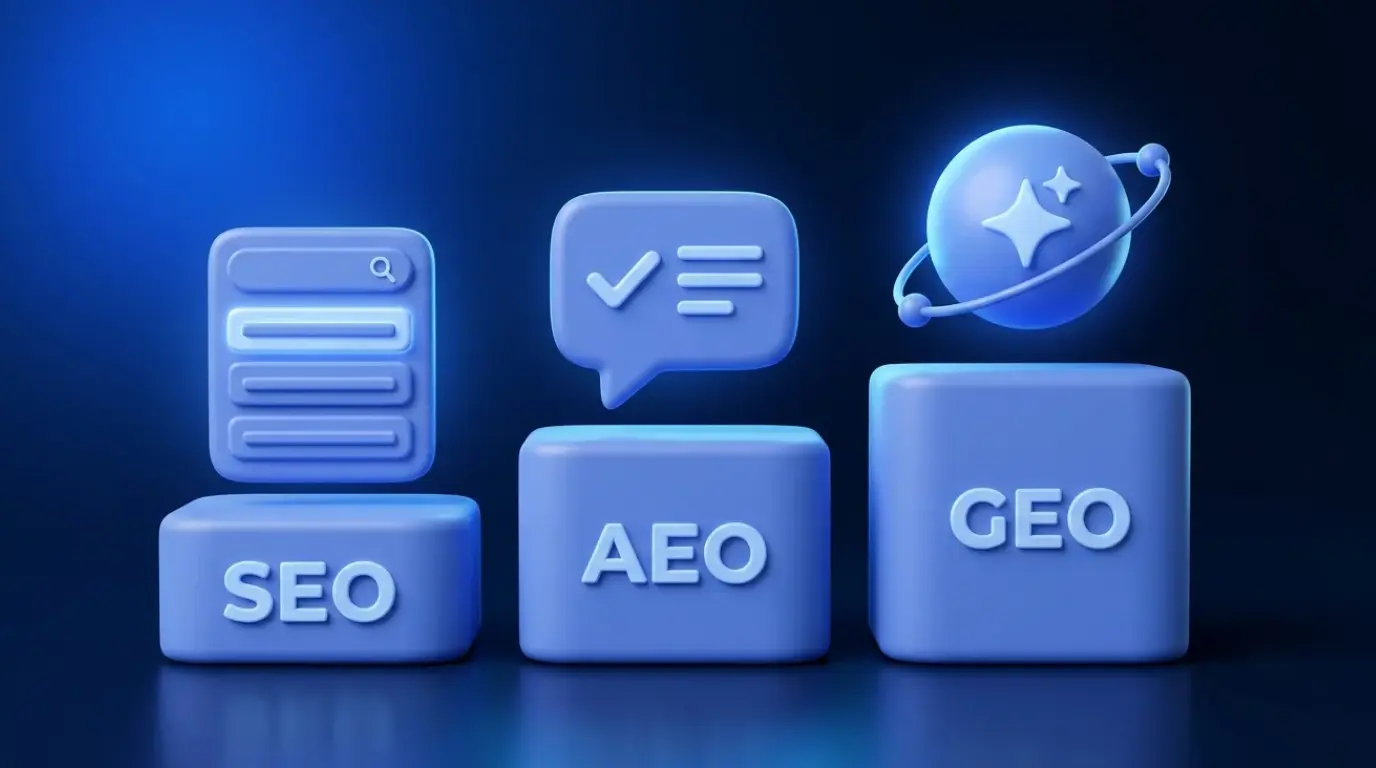
Think of modern search visibility as a three-layer ecosystem:
- SEO → Discoverability
- AEO → Answerability
- GEO → AI Visibility
A business that focuses only on SEO may continue receiving organic traffic but overlook emerging AI-driven discovery.
A business that focuses exclusively on AEO may produce highly structured answers without building sufficient website authority.
A business focusing only on GEO without strong foundational content may struggle to establish the credibility and information structure that modern search systems need.
The stronger approach is integration.
How Content Strategy Changes Across SEO, AEO and GEO
The biggest change isn't necessarily the amount of content a business creates.
It is how strategically that content is designed.
SEO-oriented content
Typically focuses on:
- Search demand
- Keywords
- Search intent
- Topic coverage
- Website architecture
- Authority
- Technical health
AEO-oriented content
Places greater emphasis on:
- Questions
- Direct answers
- Definitions
- FAQs
- Structured explanations
- Concise information
- Conversational language
GEO-oriented content
Requires stronger emphasis on:
- Expertise
- Context
- Original insights
- Brand authority
- Entity relationships
- Consistent information
- Evidence
- Comprehensive topic coverage
This means one high-quality article can potentially serve multiple purposes when it is strategically structured.
Why Businesses Should Think Beyond Rankings
Rankings remain an important SEO metric.
But rankings alone don't tell the entire story of modern digital visibility.
Consider two businesses.
Business A ranks for several valuable keywords but provides limited information about its expertise.
Business B has strong search visibility, detailed educational content, clear expertise, consistent brand information, and useful answers across its digital ecosystem.
The second business has more opportunities to be discovered through different forms of search.
This is an important strategic shift:
The objective is no longer simply to occupy a position on a search page.
The objective is to build a digital presence that search engines and AI systems can understand, trust, and connect with relevant user needs.
The Future of Search Is Becoming Multilayered
Search isn't disappearing.
It is expanding.
Traditional search results will continue to matter.
At the same time, users are becoming more comfortable with conversational interfaces and AI-generated answers.
This means businesses need to prepare for multiple discovery environments.
A modern customer might discover a company through:
- Google search
- An AI-generated answer
- A featured answer
- A social platform
- A review
- A business directory
- A YouTube video
- A community discussion
- A recommendation
- A branded search
The customer's journey can therefore become fragmented across multiple platforms.
A strong digital strategy needs to account for that reality.
Futuready Search Visibility Framework™
Futuready Media approaches modern search visibility through six connected stages:
1. Discover
Identify the topics, questions, problems and commercial searches that matter to the target audience.
2. Structure
Organize the website and content so important information is easy to understand and discover.
3. Answer
Create clear content that addresses user questions directly instead of forcing users to search through long pages for basic information.
4. Demonstrate
Build expertise through original insights, useful resources, evidence, experience and consistent brand information.
5. Optimize
Improve technical performance, content structure, entities, internal linking, structured data and overall discoverability.
6. Measure
Track visibility across organic search, answer-driven experiences, brand discovery and business outcomes.
This framework moves the strategy away from isolated optimization tactics and toward a broader search visibility model.
What Should Businesses Prioritize?
The answer depends on the business.
A new local business may initially need strong SEO foundations.
An established company with substantial content may benefit from improving answer-focused content.
A recognized brand operating in competitive categories may increasingly need to consider visibility across AI-driven discovery environments.
The important point is that these priorities can evolve.
A business shouldn't ask:
"Should we do SEO, AEO or GEO?"
A better strategic question is:
"How can we make our brand discoverable, understandable and credible across the different ways customers search?"
That question reflects how search behaviour is evolving.
The Role of AI in Modern Search Strategy
AI is changing both sides of search.
Consumers use AI to discover information.
Businesses use AI to research topics, analyze search behaviour, create content and identify opportunities.
But automation doesn't automatically create authority.
Producing hundreds of AI-generated articles won't necessarily establish a credible digital presence.
Businesses still need:
- Original perspectives
- Accurate information
- Subject expertise
- Useful experiences
- Strong editorial standards
- Consistent brand messaging
- High-quality websites
- Relevant external authority
AI can accelerate content operations, but strategic direction remains essential.
A Practical Example
Consider a company offering website development services.
A traditional strategy might focus on ranking for:
"website development company"
A broader modern strategy could create content addressing:
- What does a business website need?
- How much does website development cost?
- When should a company redesign its website?
- What makes a website high-performing?
- How does website speed affect conversions?
- What should businesses ask a website development agency?
- How does website development influence SEO?
Now the company isn't targeting just one search.
It is building a knowledge ecosystem around the customer's decision-making process.
That ecosystem can support organic visibility, answer-focused discovery, AI-generated responses and ultimately commercial conversions.
The Future Is Not SEO vs AEO vs GEO
The title may suggest competition between three disciplines.
The reality is more interconnected.
SEO provides the foundation for discoverability.
AEO improves the ability of content to directly address questions.
GEO extends the visibility conversation into AI-driven discovery.
Together, they represent a broader shift:
From ranking pages to building searchable knowledge.
This is perhaps the most important change businesses need to understand.
The future of search won't necessarily reward businesses simply because they produce more content.
It will increasingly reward businesses that provide clear, credible, useful and contextually relevant information.
How Businesses Can Prepare Today
Businesses don't need to completely rebuild their digital strategy overnight.
They can begin with a structured audit.
Website
Check whether important products, services and expertise are clearly represented.
Content
Identify whether content genuinely answers customer questions.
Search intent
Review whether pages address informational, commercial and transactional needs.
Authority
Assess whether the business demonstrates real expertise and credibility.
Brand consistency
Make sure important company information remains consistent across digital platforms.
Technical foundation
Review website speed, indexing, structured data, internal linking and crawlability.
Measurement
Expand reporting beyond rankings and traffic to include engagement, conversions and brand discovery.
These steps create a stronger foundation for the evolving search environment.
Final Thoughts
Search is moving from a simple query-and-ranking model toward a more conversational, contextual and answer-driven ecosystem.
SEO remains an essential foundation.
AEO addresses the growing importance of direct answers.
GEO responds to the rise of AI-generated discovery.
The businesses that adapt successfully will not necessarily abandon traditional search practices. Instead, they will expand their understanding of what search visibility means.
The future belongs to brands that can be:
Found.
Understood.
Trusted.
Referenced.
And ultimately, chosen by the customer.
That requires more than optimization.
It requires a digital presence built around genuine expertise, useful information and a clear understanding of how people discover businesses.
Commonly asked.
Honestly answered.
SEO primarily focuses on improving organic search visibility, AEO focuses on providing direct answers to user questions, while GEO focuses on increasing visibility within AI-generated search experiences.
Yes. Strong technical foundations, useful content, authority and discoverability remain important even as search interfaces evolve.
No. FAQs are one useful format, but answer-focused optimization can also involve definitions, comparisons, structured explanations, how-to content and concise responses to specific questions.
No. GEO should generally be viewed as an extension of a broader digital visibility strategy rather than a complete replacement for search optimization.
AI-powered search can reduce the need for users to visit multiple pages to gather basic information. Users can increasingly receive synthesized responses and then decide whether they need to investigate a particular brand or source further.
Comprehensive, accurate and well-structured content can support multiple search environments. Content should address search intent, answer important questions, demonstrate expertise and provide useful context.
Start with strong website fundamentals, useful customer-focused content, clear service information, technical optimization, local visibility, authority building and consistent brand information.
Yes. Rankings are useful, but businesses should also monitor organic traffic, engagement, conversions, branded searches, qualified leads and other indicators of business impact.
There is no basis for assuming that traditional search will simply disappear. Search behaviour is evolving, and AI-driven interfaces are being added to the broader discovery ecosystem.
Businesses should move from thinking only about ranking individual pages toward building a comprehensive digital knowledge ecosystem that answers customer questions and demonstrates expertise across multiple discovery environments.