The Invisible Website Problem: Ranking on Google but Not Appearing in AI Search Results
Your website is on Page 1. Your SEO is working. The traffic reports look reasonable. But when someone asks ChatGPT or Perplexity to recommend a service provider in your category, your brand does not appear. Your competitor does.
This is the invisible website problem. And it is affecting far more businesses than most marketing teams have noticed yet.
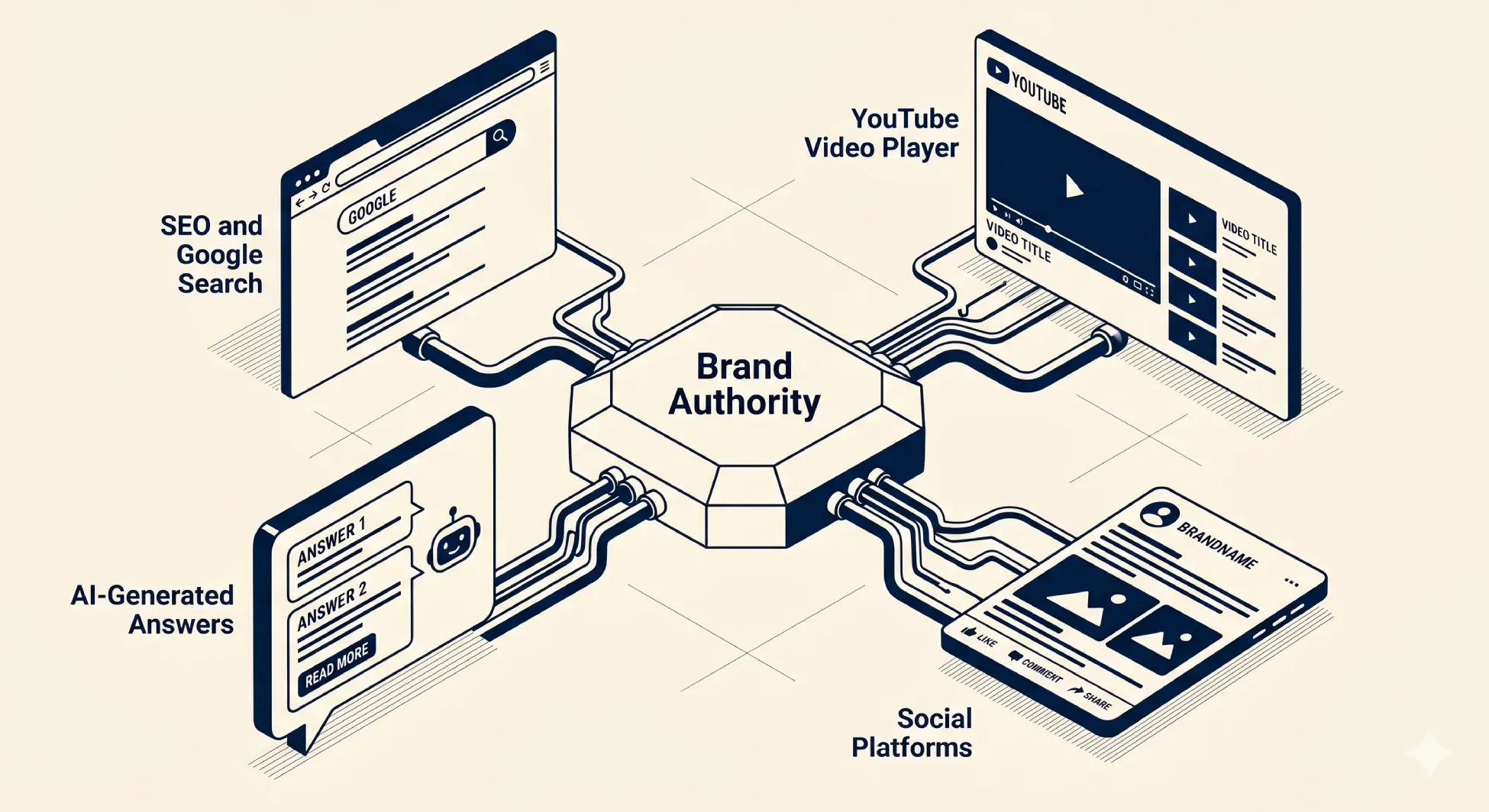
Google rankings and AI search visibility are two different things. Winning one does not guarantee the other. Businesses that built their entire digital presence around traditional SEO are now discovering that a significant and growing share of buyer research is happening on AI platforms where their brand simply does not exist. Understanding why this gap exists and how to close it is one of the most important things a marketing team can do in 2026. Our SEO, AEO and GEO service is built specifically to address both traditional search visibility and AI platform presence at the same time.
Why Google Rankings No Longer Tell the Full Story
For almost two decades, appearing on Page 1 of Google was the ultimate measure of digital visibility. If you ranked, you existed. If you did not rank, you were invisible.
That model is breaking down.
AI tools are now intercepting a growing portion of search queries before users ever scroll through results. When someone types a question into ChatGPT, opens Perplexity, or uses Google AI Overviews, they are getting a synthesised answer built from multiple sources. They are not necessarily clicking through to individual websites. They are reading a curated response and making decisions based on which brands appeared in it.
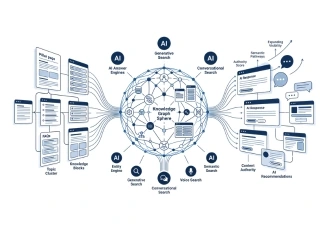
The brands that appear in those responses are not always the ones ranking highest on Google. They are the ones whose content is structured in a way that AI systems can read, understand, trust, and cite.
This distinction is the entire basis of the invisible website problem. Your traditional SEO tells Google your content is relevant. But AI tools are making a different judgement. They are evaluating whether your content is authoritative enough, structured clearly enough, and specific enough to be used as a source in a generated answer. Many websites that rank well on Google fail all three of those tests.
How AI Tools Decide What to Recommend
To understand why your website might be invisible to AI search, you need to understand how these tools actually work.
Large language models and AI answer engines are trained on vast amounts of data. But when they generate real-time answers, they look for content that meets a specific set of criteria. They want information that is clearly structured with logical headings and clean hierarchy. They want content that directly answers a specific question rather than dancing around it. They want sources that demonstrate authority through depth, accuracy, and consistency across the web. And they want brands that have enough external references pointing back to them to confirm they are real, credible, and relevant.
Most traditionally optimised websites are built to satisfy Google's crawlers. They have keywords in titles, meta descriptions, and alt text. They have internal links and a sitemap. They load at an acceptable speed.
None of that is enough for AI visibility.
A website that answers questions vaguely, uses jargon-heavy language, buries its expertise behind generic corporate copy, and has little external validation from third party sources is one that AI tools will quietly overlook. Even if Google considers it relevant, the AI will find a more citable source and use that instead.
The Four Reasons Your Website Is Invisible to AI
There are four patterns that consistently explain why a well-ranked website disappears from AI search results. Most businesses are dealing with at least two of them simultaneously.
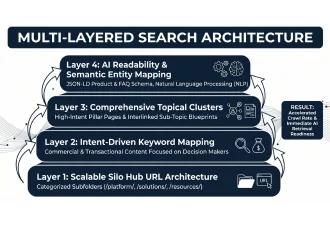
Your content answers topics but not questions. Traditional SEO content is built around keywords. A blog post targeting "content marketing strategy" covers the topic broadly. But AI tools are looking for content that answers specific questions with direct, structured responses. If your content does not have clear question-and-answer formatting, defined FAQs, or direct definitional statements, AI systems have a harder time extracting a citable answer from it. The content exists but it cannot be used.
Your website lacks structured data. Schema markup is the technical language that tells both search engines and AI systems what your content means, not just what it says. FAQ schema, Article schema, Organisation schema, and Service schema are all signals that help AI tools understand your content's context and credibility. Websites without structured data are making AI tools do interpretive work. Most AI tools will simply move on to a source that has already done that work for them.
Your brand has weak external authority. AI tools weight their recommendations based on how often and how consistently a brand is mentioned across the wider web. Industry publications, partner websites, press coverage, directories, and third party reviews all feed into this. A brand that only exists on its own website, no matter how well-ranked, is a brand that AI tools cannot confidently recommend. The absence of external signals reads as a lack of credibility.
Your content is too broad to be citable. AI answers are specific. They cite sources that make precise, verifiable claims. A service page that says "we help businesses grow through digital marketing" gives an AI tool nothing specific enough to include in a response. A page that says "we help B2B manufacturing companies generate leads through SEO-driven content and AEO-optimised service pages" gives the AI system a specific claim it can verify and cite. Specificity is the currency of AI visibility.
What GEO and AEO Actually Mean for Your Business
Generative Engine Optimisation and Answer Engine Optimisation are terms that get used frequently but rarely explained in a way that tells a business owner what to actually do differently.
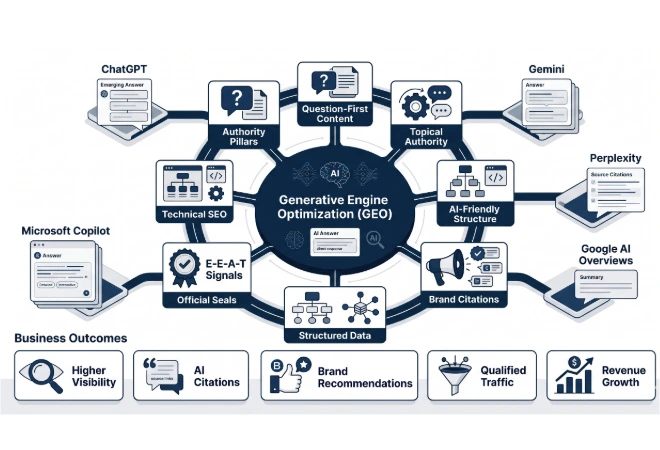
GEO is the practice of making your brand, content, and digital presence readable, credible, and citable for AI systems that generate answers. It includes structured content, external authority building, consistent brand signals across the web, and content written to answer specific questions rather than rank for broad topics.
AEO is the practice of structuring your content so it appears in featured snippets, voice search results, and AI-generated direct answers. It involves FAQ sections with direct answers, clear definitional statements, concise question-based headings, and schema markup that tells search and AI systems exactly what type of content they are reading.
Together, GEO and AEO address the gap that traditional SEO leaves open. They are not replacements for SEO. They are the layers that sit on top of it and extend your visibility into the channels where buyers are increasingly spending their research time.
The brands that are winning AI visibility right now are not necessarily the biggest or the most established. They are the ones that understood this shift early and restructured their content accordingly. A well-built content marketing strategy that incorporates AEO and GEO principles is one of the fastest ways to close the gap between your Google rankings and your AI search presence.
The Content Restructuring That AI Visibility Requires
Fixing an invisible website is not about starting from scratch. It is about restructuring what you already have and adding what is missing.
The first step is auditing your existing content for answer-readiness. Go through your highest-traffic pages and ask one question: if an AI tool were trying to extract a single clear answer from this page to include in a generated response, could it find one? If the answer is no, the content needs restructuring. Add clear question-based subheadings. Add concise direct answers at the top of each section. Add an FAQ section at the bottom of every service page and blog post with specific, direct responses to the questions your buyers are actually asking.
The second step is implementing structured data across every key page. Every service page needs Service schema. Every blog post needs Article schema. Every FAQ section needs FAQ schema. Your homepage and about page need Organisation schema with accurate, consistent business information. This is not optional if AI visibility is a goal. It is the foundation.
The third step is building external authority deliberately. Identify the publications, directories, and platforms where your ideal buyers consume information. Get your brand mentioned in those places through contributed articles, expert quotes, partnerships, and press coverage. Each external mention is a signal that tells AI tools your brand is real, active, and credible in its field.
The fourth step is creating content specifically designed to be cited in AI responses. This means writing precise, specific, authoritative pieces on topics where you have genuine expertise. Not broad overviews. Not repackaged general knowledge. Specific insights, specific frameworks, specific data points that an AI tool could include in an answer and attribute to your brand.
Understanding how all of this connects to the broader journey from discovery to conversion is important. Our blog on mapping every digital touchpoint that drives conversions covers exactly how AI search visibility feeds into the wider revenue journey for businesses investing in organic growth.
The Compounding Cost of Staying Invisible
The invisible website problem is not static. It gets more expensive the longer it goes unaddressed.
Every month that your brand is absent from AI search results is a month where a buyer asking an AI tool for recommendations in your category is being directed to a competitor. That buyer may never visit your website at all. They found what they needed before they reached traditional search results.
As AI tools become more integrated into the research process, the share of buyer journeys that begin and potentially end in AI-generated responses will continue to grow. The businesses that solve this problem now are building a compounding advantage. Their content becomes more citable over time. Their external authority grows. Their brand begins appearing in AI responses with increasing frequency.
The businesses that wait are not standing still. They are falling further behind in a race they may not have realised they had entered.
Traditional SEO built your website's visibility in one era of search. GEO and AEO are building visibility for the era that has already arrived. The brands that thrive in 2026 and beyond are the ones treating both with equal strategic seriousness.
If your website is ranking on Google but disappearing from AI answers, the gap is real, it is measurable, and it is fixable. But only if you start treating AI search visibility as its own discipline, with its own content requirements, its own technical foundations, and its own ongoing investment.
The businesses showing up in AI answers right now did not get there by accident. They built for it. And the window to build that advantage before your category becomes saturated is still open, but it will not stay open indefinitely.
Commonly asked.
Honestly answered.
Google SEO optimises your website to rank in traditional search results through keywords, backlinks, and technical performance. AI search visibility is about whether AI tools like ChatGPT, Perplexity, and Google AI Overviews cite your brand in generated answers. The two use different criteria. Google weighs relevance and authority. AI tools weigh structure, specificity, and how easily content can be extracted and cited in a direct answer. You can rank well on Google and still be completely absent from AI results.
Your competitor's content is likely more structured, more specific, and more externally referenced than yours. AI tools favour content with clear question-and-answer formatting, FAQ sections, structured data markup, and consistent mentions across third party sources. If your competitor has invested in AEO and GEO practices and you have not, they will appear in AI-generated answers even if your Google rankings are comparable or better.
Answer Engine Optimisation is the practice of structuring your content so it appears in AI-generated direct answers, featured snippets, and voice search responses. It involves writing content that directly answers specific questions, using question-based headings, implementing FAQ schema markup, and creating concise definitional statements that AI tools can extract and cite. It is a content and technical practice that sits alongside traditional SEO rather than replacing it.
There is no fixed timeline because AI tools do not index content on a public schedule the way Google does. Most businesses start seeing early indicators of AI visibility improvement within two to four months of implementing structured content, schema markup, and external authority building. Full, consistent citation in AI-generated answers typically develops over six to twelve months as the brand's external signals accumulate and its content authority grows.
Yes. Schema markup provides AI systems with a structured interpretation of your content. Without it, AI tools have to infer what your content means. With it, you are explicitly communicating what type of content it is, who it is for, what questions it answers, and what your business does. FAQ schema in particular is one of the most direct ways to make content citable in AI-generated responses because it presents information in exactly the format AI tools are looking to include in their answers.
Yes, and this is one of the more equalising aspects of AI search. Large brands have domain authority advantages in traditional Google SEO that are very difficult for smaller businesses to overcome. AI tools are less concerned with domain authority and more concerned with content quality, structure, and specificity. A small business that publishes precise, well-structured, expert content on a specific topic can appear in AI-generated answers alongside or instead of much larger competitors who have broader but less specific content.
Content that makes specific, verifiable claims in a clear, structured format. This includes well-structured FAQ sections with direct answers, detailed service or product descriptions with precise specifications, expert opinion pieces with concrete frameworks, industry-specific guides that cover a topic with genuine depth, and research or data-backed articles. Generic overview content, vague brand copy, and broad topic surveys are the types of content AI tools are least likely to cite because they do not contain the specific, extractable information that makes for a useful generated answer.