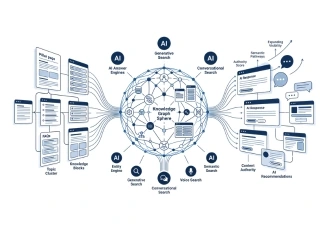
SEO vs AEO vs GEO: The Complete 2026 Guide for Businesses in India
Not too long ago, ranking on Google meant stuffing the right keywords into a webpage and building a few backlinks. That era is over.
Today, a business owner in Pune asks Google, "Which B2B digital agency in Mumbai handles both branding and performance marketing?" and instead of ten blue links, they get a crisp AI generated paragraph with a direct answer, three cited sources, and a follow up question prompt. No scrolling. No clicking through pages. Just an answer.
This is not a future prediction. This is how Indian buyers search right now in 2026.
For businesses operating in India, especially in competitive B2B spaces, understanding the difference between SEO, AEO, and GEO is no longer optional. These three disciplines now work together to determine whether your brand shows up in traditional search results, in voice responses, or inside the AI generated answers that tools like ChatGPT, Google SGE, and Gemini are serving to millions of users every day. This is precisely why forward thinking brands are now investing in AI driven digital solutions alongside their core marketing strategy.
Let us break down each one clearly and show you exactly how to build a strategy around all three.
What Is SEO in 2026?
Search Engine Optimization has evolved significantly. The keyword stuffing tactics of 2012 have given way to something far more sophisticated: semantic, intent driven, and entity based optimization.
Modern SEO is about helping search engines understand the full meaning of your content, not just individual words. Google's algorithms now evaluate topics, context, and topical authority. A page that covers a subject deeply and connects naturally to related ideas will outperform a page that simply repeats a keyword fifteen times.
Three pillars define SEO in 2026:
Semantic Search:
Google understands synonyms, related concepts, and natural language. Writing for humans and covering a topic thoroughly is the strategy that works.
Intent Driven Content:
Every search query carries an intent, whether informational, navigational, commercial, or transactional. Your content must match that intent precisely.
Entity Based Optimization:
Google's Knowledge Graph maps relationships between people, brands, products, and concepts. Building your brand as a recognized entity through consistent mentions, structured data, and authoritative coverage is now a core ranking factor.
A good way to understand this in practice: one of our clients in the B2B manufacturing space saw a 40% improvement in organic traffic within six months after we restructured their content around topic clusters rather than isolated keywords. The shift was not about more content. It was about smarter, more connected content built around their core services and audience intent.
Our digital marketing services are built on this evolved understanding of SEO, combining technical excellence with content strategy that actually performs.
What Is AEO (Answer Engine Optimization)?
Answer Engine Optimization is the practice of structuring your content so that search engines and AI tools can extract and present it as a direct answer.
When someone asks Google "What is the best digital marketing strategy for a B2B company in India?", the featured snippet at the top of the results page is not there by accident. That answer was earned through deliberate AEO.
AEO focuses on three things:
Featured Snippets:
Structuring answers in a clear, concise format (40 to 60 words for paragraph snippets, clean numbered lists for processes) so Google can pull your content into position zero.
Voice Search Optimization:
Voice queries are conversational and question based. "Hey Google, how do I improve my company's website ranking in India?" requires very different content structure than a typed query.
Question Based Content:
Building content around real questions your audience is asking. Tools like "People Also Ask" and search autocomplete reveal exactly what your buyers want to know. Answering those questions directly and confidently is the AEO playbook.
AEO works best when your content is structured clearly and written in plain language. This is why our content strategy services always begin with a question mapping exercise, understanding what your audience is actually asking before a single word is written.
What Is GEO (Generative Engine Optimization)?
Generative Engine Optimization is the newest and fastest growing discipline in the search landscape. It focuses specifically on getting your brand cited, referenced, or surfaced inside AI generated responses from tools like ChatGPT, Google's AI Overviews, Gemini, and Perplexity.
When a user asks an AI tool a business question, the model does not crawl the web in real time. It synthesizes information from sources it has been trained on or is connected to through retrieval. Brands that appear consistently in authoritative, well structured, and frequently cited digital content have a higher probability of appearing in those generated answers.
GEO strategy is built on three foundations:
LLM Visibility:
Being present in the content sources that large language models reference, which means authoritative blog content, industry publications, press mentions, and high quality backlinks.
Content Structuring for AI:
Using clear headings, concise definitions, factual statements, and structured data (Schema markup) so AI systems can parse and use your content confidently.
Topical Authority:
AI models trust sources that cover a topic deeply and consistently. A brand that publishes fifteen well researched articles on B2B digital marketing strategy will be referenced far more than a brand with one generic overview post.
This is a discipline that sits at the intersection of content, technical SEO, and brand building, which is exactly where our digital strategy team operates.
SEO vs AEO vs GEO: Side by Side Comparison
| Factor | SEO | AEO | GEO |
|---|---|---|---|
| Primary Goal | Rank in organic search results | Appear as featured answers | Be cited in AI generated responses |
| Target Platform | Google, Bing | Google Featured Snippets, Voice | ChatGPT, Gemini, Google AI Overviews |
| Content Format | Long form, keyword optimized | Short, question and answer format | Authoritative, structured, factual |
| Key Tactic | Entity optimization, backlinks | FAQ structure, schema markup | Topical authority, LLM ready formatting |
| Measurement | Rankings, organic traffic | Featured snippet capture rate | AI citation frequency, brand mentions |
| Time to Impact | 3 to 6 months | 4 to 8 weeks | 2 to 6 months |
The key insight here is that these three are not competing strategies. They are layers of the same modern search presence. A business that optimizes for all three will dominate across traditional search, voice, and AI platforms simultaneously.
Why Businesses in India Must Adapt Right Now
India is one of the fastest growing AI adoption markets in the world. As of early 2026, over 200 million Indians are active users of AI tools for research, purchasing decisions, and professional queries. Google's AI Overviews are now active across Indian search results. Voice search has crossed 30% of mobile queries in Tier 1 and Tier 2 cities.
For B2B businesses, the stakes are particularly high. Decision makers at Indian companies are increasingly using AI tools to shortlist vendors, evaluate agencies, and research solutions before ever visiting a website. If your brand does not appear in those AI generated shortlists, you are invisible at the most critical moment in the buyer's journey.
The competitive advantage right now belongs to early movers. Most Indian businesses are still running SEO strategies built for 2019. The brands that build an integrated SEO, AEO, and GEO framework today will be the ones that own their categories by 2027.
Our work with brands across sectors including real estate, pharmaceuticals, and financial services has consistently shown that businesses with a structured digital content approach generate significantly higher inbound quality and shorter sales cycles. You can explore how we approach this through our work portfolio.
A Practical Strategy to Get Started
Step 1: Audit Your Existing Content for Intent Alignment
Map every key page to a specific search intent. If a page is trying to serve informational and transactional intent simultaneously, split it.
Step 2:Build a Question Based Content Layer
Identify the top 20 questions your buyers ask at each stage of their journey. Create dedicated, focused content pieces that answer each one with authority. This serves both AEO and GEO simultaneously.
Step 3:Implement Schema Markup Across Key Pages
FAQ schema, Article schema, Organization schema, and BreadcrumbList schema are the minimum baseline. For B2B businesses, adding Product and Service schema creates significant visibility advantages.
Step 4:Develop Topical Authority Through Content Clusters
Group your content into pillar topics and supporting subtopics. A strong internal linking structure signals topical depth to both Google and AI systems.
Step 5:Optimize for Conversational Queries
Rewrite key sections of your content in a natural, conversational tone. AI tools favor content that reads the way people actually speak and ask questions.
If you are looking to implement this as a cohesive system, our web development and technical SEO capabilities cover the full technical layer from schema implementation to site architecture.
Final Thought
Search in India is not what it was two years ago, and it will look completely different two years from now. The businesses that win will be the ones that understand this shift early and build content ecosystems that are visible to traditional search engines, answer engines, and AI tools alike.
SEO, AEO, and GEO are not three separate strategies. They are three dimensions of the same goal: being the most credible, visible, and referenced brand in your space.
The question is not whether to adapt. The question is whether you do it before or after your competitors do.
Ready to build a search strategy that works across Google, AI Overviews, and generative tools? Get in touch with the Futuready team to start the conversation.
Commonly asked.
Honestly answered.
SEO focuses on ranking your website pages in traditional search engine results through keyword optimization, backlinks, and technical performance. AEO focuses specifically on having your content selected as the direct answer to a query, appearing in featured snippets, voice results, and People Also Ask sections. AEO is a subset of modern SEO strategy.
GEO is the practice of optimizing your digital content so that AI tools like ChatGPT, Google Gemini, and Perplexity cite or reference your brand when generating answers for users. It involves building topical authority, using structured content formats, and maintaining a strong authoritative digital presence.
Absolutely. Traditional organic search still drives the majority of website traffic for most businesses. However, SEO in 2026 must work in coordination with AEO and GEO strategies to ensure visibility across both traditional and AI powered search platforms.
AEO results such as featured snippet wins can appear within four to eight weeks of implementing structured content and FAQ schema. GEO results typically take two to six months as AI systems need time to index, evaluate, and begin referencing new content sources.
Start with a strong SEO foundation as it underpins both AEO and GEO. Simultaneously implement FAQ schema and question based content for quick AEO wins. Then build toward GEO through consistent, authoritative long form content that establishes topical depth in your category.