Your Competitors Aren't Better — They're Just Structured Better: A Breakdown of Winning Digital Strategies
At some point, every founder or marketing head has asked the same uncomfortable question. Why is that competitor winning? Their product is not better. Their team is not bigger. Their prices are not lower. And yet they are showing up everywhere. Their content ranks. Their ads follow people around. Their name comes up in conversations. And your business, despite doing everything you believe is right, stays quietly in second place.
The answer is almost never about quality. It is almost always about structure.
The brands that consistently outperform their competition online are not doing more. They are doing things in a specific order, with a specific logic connecting every channel to every other channel. That structure is what creates compounding visibility, consistent leads, and a brand that feels bigger than it actually is. If you want to understand what that structure looks like in practice, our digital strategy work is built around exactly this kind of competitive architecture for growing businesses.
What Structure Actually Means in Digital Marketing
When most businesses hear the word strategy, they think of a plan. A document. A set of goals with timelines attached.
That is not what structure means here.
Structure in digital marketing means that every channel, every piece of content, every campaign, and every touchpoint is designed to do a specific job and hand off to the next stage deliberately. Nothing exists in isolation. Nothing is published without a purpose that connects to a commercial outcome.
A structured competitor is not running ads and also doing SEO and also posting on social media. They are running ads that reinforce what the SEO content has already said, social media that builds familiarity with the audience the ads are targeting, and a website that converts the trust all three channels have built. Each one feeds the next. The buyer's journey feels seamless because it was designed to be seamless.
An unstructured business is doing all the same activities but none of them are connected. The ads say something different from the website. The social content has nothing to do with the SEO strategy. The blog exists but nobody internally can explain what it is supposed to achieve. The budget is spread across channels but there is no architecture underneath any of it.
That gap between structured and unstructured is where competitive advantage lives in 2026.
Layer One: The Competitor's Brand Foundation Is Not an Accident
The first thing that separates a structurally strong competitor from one that is struggling is positioning clarity.
Winning brands know exactly who they are for, what specific problem they solve, and why a buyer should choose them over every alternative. That clarity is not just a brand exercise. It is the foundation that every other marketing decision is built on.
When positioning is clear, the website headline speaks directly to the right buyer. The ad copy has a specific angle rather than a generic claim. The sales conversation starts from a place of authority rather than explanation. The content strategy has a coherent point of view rather than a collection of topics.
When positioning is vague, the opposite happens at every level. The website says something like "we deliver innovative solutions for modern businesses." The ads say something equally general. The content covers everything broadly and nothing deeply. The sales team pitches differently every time because the brand has not given them a consistent story to tell.
Your competitor who appears stronger almost certainly has cleaner positioning than you do. They decided who they are for, said it clearly and consistently everywhere, and built everything else on top of that decision. That single choice cascades into advantages across every channel simultaneously.
Layer Two: Their Website Is Built to Convert, Not Just to Impress
The second structural advantage that winning competitors have is a website that functions as a revenue asset rather than a digital brochure.
Most business websites are built to communicate. They explain what the company does, list the services, show some client logos, and provide contact details. That is a presentation. It is not a conversion system.
A website built for performance is structured around the visitor's decision journey. Every page answers a specific question a buyer would have at a specific stage of their evaluation. The homepage answers "are you the right type of company for my problem." The service pages answer "can you specifically solve what I am dealing with." The case studies answer "have you done this for someone like me." The contact page reduces the perceived effort of reaching out.
Each of those pages has a clear primary action it is guiding the visitor toward. The calls to action are specific, not generic. The trust signals appear at the moment the visitor is deciding, not buried in a footer. The page loads fast enough that intent is not killed before the content even appears.
This is also why web design and development is a strategic function in a winning competitor's business, not a one-time project handed to the cheapest vendor available. The site is treated as a living conversion asset that gets tested, refined, and improved as data comes in.
Layer Three: Their Content Works as a System, Not a Calendar
The third structural difference is how winning competitors think about content.
Businesses that are losing to competitors on organic search are almost always producing content as a calendar activity. Someone decides on a topic, a writer produces it, it gets published, and then everyone moves on to next month's calendar. The content exists. It just does not work.
Winning competitors produce content as a system. Every piece has a role in the buyer journey. Every blog post targets a specific query that a buyer in their category actually searches for. The posts link internally to service pages, to case studies, to related articles, building a web of authority rather than a collection of standalone pieces.
The content is not just written for Google either. It is structured to be cited by AI search tools, formatted to appear in featured snippets, and designed to be repurposed into social media posts, email sequences, and ad creative. One well-built content piece does multiple jobs across multiple channels.
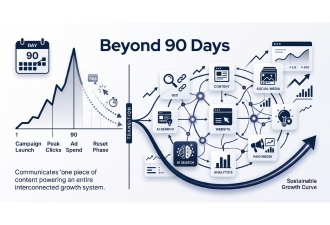
This is the principle behind the 5-layer content system where blog, video, ads, social, and SEO are not separate activities but interconnected layers that amplify each other. Competitors who understand this publish less but get significantly more return from every piece they produce.
Layer Four: Their SEO and Paid Channels Reinforce Each Other
One of the clearest signs of structural weakness in a marketing operation is when the SEO team and the paid media team are working from completely different briefs.
This is extremely common. And it is one of the most expensive structural mistakes a business can make.
The organic search strategy tells you which topics, keywords, and questions your buyers care about at every stage of their journey. That intelligence should directly inform which audiences to target in paid campaigns, what messaging to lead with, and which landing pages to send paid traffic to.
When SEO and paid media are integrated, the paid campaigns get smarter because they are built on real organic data. The organic strategy gets faster results because paid campaigns validate which content themes are actually converting. The overall cost per lead drops because both channels are aimed at the same buyer with a coherent, consistent message.
When they are siloed, both channels underperform. The paid team runs campaigns based on what has historically been cheap to click. The SEO team optimises for what is historically been easy to rank. Neither is asking what actually converts the specific buyer your business needs to attract.
The winning competitors in your category have connected these two channels deliberately. Their paid campaigns feel like an extension of their content. Their organic rankings validate the same positioning their ads are pushing. The buyer encounters the same brand story repeatedly across both channels and familiarity builds trust without the business having to pay for every single touchpoint.
Layer Five: Their Measurement Is Connected to Revenue, Not Vanity
The final structural advantage that winning competitors have is how they measure performance.
Most businesses measure marketing by channel metrics. Impressions, followers, click-through rates, keyword rankings, email open rates. These metrics feel meaningful because they move. They go up and down and give teams something to report on in weekly meetings.
But none of them tell you whether the marketing is making money.
Structurally strong competitors measure their digital activity by its contribution to revenue. They track how many leads came from organic search, what the cost per lead was from paid campaigns, which content pieces are responsible for the highest-quality inquiries, and how the overall marketing investment is affecting pipeline and closed business.
This measurement discipline changes the decisions they make. Channels that look impressive on vanity metrics but produce no leads get de-prioritised. Content topics that consistently attract buyers who convert get expanded. Campaigns that produce cheap clicks but expensive leads get restructured around the offer rather than the targeting.
Understanding how every digital touchpoint maps to an actual revenue outcome is what our blog on mapping every digital touchpoint that drives conversions covers in detail. It is the measurement framework that separates businesses that know their marketing is working from those that hope it is.
What Closing the Gap Actually Looks Like
If your competitor is outperforming you, the temptation is to do more. More content. More ads. More channels. More budget.
That instinct almost always makes the problem worse before it makes it better. Adding volume to an unstructured operation does not create structure. It creates more noise with more spend behind it.
The actual path to closing the gap starts with an honest structural audit. Where is your positioning vague? Where are your channels disconnected? Where is your content producing activity without outcomes? Where is your website creating friction instead of converting trust?
The answers to those questions are almost always more useful than any new campaign idea or channel experiment. Because the brands winning in your category have already asked and answered them. Their structure is the result of those answers being acted on consistently over time.
You are not losing because they are better. You are losing because they built a system and you are still running activities.
The good news is that structure is learnable, buildable, and once built, it compounds in ways that isolated activities never can. Our SEO, AEO and GEO service and performance marketing capabilities are built to work together precisely because of this. Structure is not a luxury. It is the entire game.
Commonly asked.
Honestly answered.
Google does not rank products. It ranks pages. A competitor with a structurally sound website, clear topical authority, consistent internal linking, and well-optimised service pages will outrank a better product sitting on a poorly structured site almost every time. Rankings reflect the quality of the digital infrastructure around the product, not the product itself. Fixing the structural gaps in your content and technical SEO is what closes that gap.
A structured digital marketing strategy includes clear brand positioning that informs all channels, a website built around the buyer's decision journey, a content system mapped to search intent at every stage of the funnel, SEO and paid media working from the same brief, and measurement tied to revenue outcomes rather than channel-level vanity metrics. Each element is designed to support the others rather than operate independently.
The clearest test is asking one question about each channel: what specific commercial outcome is this designed to produce? If the honest answer for any channel is "visibility" or "engagement" without a clear connection to leads or revenue, that channel is active but not structured. A structured channel has a defined role in the buyer journey, a clear metric tied to business outcomes, and a deliberate connection to at least one other channel in the system.
Yes, and this happens regularly. A well-structured content and SEO strategy compounds over time, producing organic visibility that larger budgets cannot simply buy. A competitor spending significantly more on ads but sending that traffic to a poorly converting website will consistently produce a higher cost per lead than a business with a smaller budget but a high-converting landing page and clear messaging. Structure multiplies the value of every rupee spent. Budget without structure is simply expensive.
The foundational layer, positioning, website architecture, and content strategy framework, can be built within six to ten weeks. The compounding results from that foundation build over three to twelve months as content gains authority, SEO rankings improve, and paid campaigns are refined using organic data. The businesses that see the fastest results are those that commit to the full structure rather than implementing individual elements in isolation.
Publishing for the calendar rather than the buyer journey. Content that fills a publishing schedule without being mapped to specific search intent, specific buyer questions, or specific stages of the decision process generates impressions but not intent. The structural fix is building a content plan that starts with the buyer's questions and works backward to the formats and topics that answer them, then connecting each piece to a service page, a case study, or a conversion point.
Not necessarily. The issue with a single-channel approach is that it creates a ceiling. A business that only does SEO will plateau when it has exhausted its content opportunities without paid amplification or social distribution. A business that only runs ads will face rising costs without organic content reducing their dependency on paid spend. The goal is not to do all channels from day one but to build each new channel deliberately so it connects to and reinforces what already exists.