Why Most Digital Marketing Strategies Fail in 90 Days and How to Build a Sustainable Growth System
The pattern is familiar to almost every founder or marketing head who has invested in digital marketing more than once. Month one feels like momentum. Month two produces some results. By month three, the numbers flatten. By month four, the conversation turns to why it is not working and what to try next.
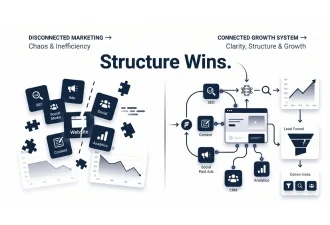
This is not bad luck. It is not the wrong agency or the wrong channel. It is a structural problem that repeats itself because most digital marketing strategies are built around campaigns rather than systems.
A campaign has a beginning, a middle, and an end. A system compounds. The distinction sounds simple. But the gap between how most businesses approach digital marketing and how growth-driving businesses approach it is almost entirely explained by that difference. Understanding what causes the 90-day failure and how to build something that grows past it is one of the most valuable things a marketing decision maker can do in 2026. Our digital strategy work is built specifically around solving this structural problem for businesses that are ready to stop resetting and start compounding.
Why the 90-Day Failure Happens
The 90-day failure is not random. It follows a consistent pattern with identifiable causes. Understanding those causes is the first step toward escaping the cycle.
Reason one: the strategy was built around tactics, not foundations.
Most businesses start digital marketing by choosing tactics. Run Meta ads. Post on LinkedIn. Start a blog. Optimise the homepage. Each of these is a reasonable activity. None of them is a strategy. When tactics are chosen before foundations are laid, they produce initial results through novelty and audience freshness, and then plateau once that novelty expires.
The foundations that tactics must rest on are positioning clarity, a well-converting website, a content architecture that builds topical authority, and a measurement system that connects activity to revenue. Without these, every tactic eventually hits the same ceiling, because the underlying infrastructure was never built to support sustained growth.
Reason two: paid channels were treated as a growth strategy rather than a distribution tool.
Paid advertising produces results immediately and predictably, which makes it extremely attractive as a primary strategy. The problem is that paid channels require continuous investment to sustain results. The moment the budget stops, the leads stop. There is no compounding. There is no asset being built. You are renting attention, not building an audience.
Businesses that build a digital marketing strategy primarily on paid channels face an inescapable economics problem. As the channel matures, audience fatigue sets in, creative refreshes become more frequent, and cost per acquisition rises. What worked at a comfortable cost in month one becomes significantly more expensive by month four. The strategy does not scale. It inflates.
Reason three: channels were managed in isolation with no shared commercial goal.
SEO reports traffic. Social reports engagement. Paid reports ROAS. And none of those reports ask whether the combined effort of all three channels is producing the commercial outcome the business actually needs.
When channels operate in silos, the buyer journey breaks down. Someone sees an ad that promises one thing, lands on a page that says something different, and never encounters the retargeting content that would have kept the brand front of mind during their decision period. Each channel did its job technically. The system failed commercially.
Reason four: results were measured too early against the wrong benchmarks.
Digital marketing has a compounding return curve that is slow at the start and steep later. Organic search authority takes months to build. Brand familiarity takes repeated exposures to develop. Content assets take time to rank, accumulate backlinks, and generate consistent traffic.
Businesses that evaluate their digital marketing strategy at 90 days against immediate revenue outcomes are measuring the wrong thing at the wrong time. What should be measured at 90 days is whether the foundations are being built correctly. Revenue outcomes are a lagging indicator of strategic decisions made months earlier. Judging the strategy by its early-stage revenue numbers and abandoning it before the compounding effect begins is one of the most common and expensive mistakes in digital marketing.
What a Sustainable Growth System Looks Like
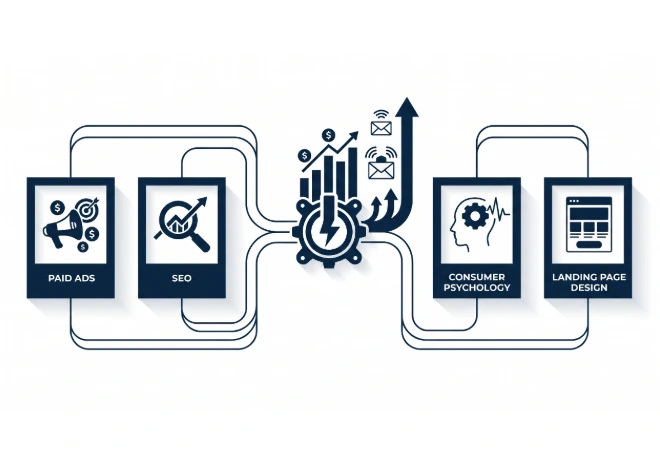
A sustainable growth system is not a better campaign. It is a different structure entirely. It is built to compound rather than to spike and fade.
Here is what that structure contains.
A fixed foundation layer that does not change with campaigns.
The foundation of a sustainable growth system is the set of assets that work continuously regardless of which campaigns are running. This includes a website built around the buyer decision journey with clear conversion architecture. A brand positioning document that gives every channel a consistent message to carry. A content strategy that maps to buyer intent at every stage of the funnel. And a measurement framework that tracks commercial outcomes rather than channel vanity metrics.
This foundation is built once and refined continuously. It does not get replaced when a new campaign launches. It is the infrastructure that every campaign amplifies.
An organic growth layer that builds authority over time.
Underneath every sustainable growth system is an organic layer. SEO that builds topical authority in the specific areas where buyers are searching. Content that answers real buyer questions and improves in ranking and value over time. A backlink profile that grows as the content earns recognition from other sources.
This layer is slow to start and resilient once built. A business that has invested two years in building genuine search authority in its category cannot be displaced by a competitor simply increasing ad spend. The organic layer creates a defensible competitive position that paid channels cannot replicate.
Our blog on why traffic does not convert even after SEO, ads, and social efforts is directly relevant here. Organic authority without conversion architecture produces the same frustration as paid spend without organic foundations. Both layers must exist and must be connected.
A paid amplification layer that accelerates what is already working organically.
In a sustainable growth system, paid channels serve a specific and bounded purpose. They accelerate the reach of organic content that has already demonstrated resonance. They re-engage audiences who have already encountered the brand through organic channels. They test messaging and offers that, once validated, feed back into organic content strategy.
This is the opposite of how most businesses use paid channels. Most businesses use paid as a primary traffic source and hope organic will eventually replace it. A sustainable system uses organic as the foundation and paid as the accelerant.
The practical implication is that paid budgets become more efficient over time rather than more expensive. Because the brand is already familiar to the audience through organic touchpoints, paid creative has a warmer audience to work with. Because organic content has validated which messages resonate, paid campaigns launch with proven angles rather than discovering them through expensive testing. Our blog on why scaling ads without fixing your website is a loss-making strategy explains precisely why paid amplification must be connected to a solid foundation to produce sustainable returns.
A social layer that builds brand familiarity between active searches.
Most buyers do not make a decision the first time they encounter a brand. Research consistently shows that B2B purchase decisions involve multiple touchpoints over an extended period. Social media is where brand familiarity is built during the gaps between those active search moments.
A business that is consistently present on social media with content that reinforces its positioning, demonstrates its expertise, and feels consistent with every other channel the buyer has encountered is building a trust asset with every post. When that buyer eventually reaches a decision moment, the brand that has been present throughout their research period has a significant advantage over the brand that appeared only in paid results.
The key word is consistent. Social media that feels disconnected from the brand's SEO content, different in tone from the website, and unrelated to the campaigns being run does not build familiarity. It creates confusion. Social media marketing that compounds requires every post to carry the same brand voice, the same strategic positioning, and the same commercial direction as every other channel in the system.
A measurement layer that tracks the right things at the right time.
The measurement framework of a sustainable growth system tracks different metrics at different stages of development.
In the first three months, the right metrics are foundation metrics. Is the website architecture correctly implemented? Is content being produced against a validated keyword strategy? Are technical SEO fundamentals in place? Is the paid strategy targeting the right audience with the right message? These are process metrics, not outcome metrics. They predict future performance.
Between months three and six, the right metrics are momentum metrics. Is organic traffic increasing? Is the cost per lead from paid channels stable or improving? Are content pieces beginning to rank for target keywords? Is social engagement increasing with the right audience? These metrics confirm the foundation is working.
From month six onward, the right metrics are compound metrics. Is organic traffic growing month-on-month without a proportional increase in content production? Is the cost per lead decreasing as brand familiarity reduces friction in the conversion process? Is the business appearing in AI search results and featured snippets? These are the metrics that demonstrate the system is compounding rather than just running.
The Role of AI and Automation in Sustainable Growth
One of the most significant developments changing the economics of sustainable digital marketing in 2026 is the availability of AI tools that handle the repetitive, time-intensive parts of a growth system without reducing their quality.
Content research, keyword clustering, performance analysis, audience segmentation, and campaign reporting are all tasks that previously required significant human time at every iteration. AI tools have reduced the time required for each of these without replacing the strategic judgment that determines what to do with the outputs.
For businesses building a sustainable growth system, this matters because it lowers the operational cost of maintaining all the layers simultaneously. A team that previously had to choose between investing time in SEO or paid or social can now maintain all three channels with the same headcount, because AI handles the volume work and human attention is reserved for the decisions that actually require judgment.
AI integration and automation in marketing is not about replacing strategy. It is about removing the operational friction that causes businesses to underinvest in the foundational layers of their growth system because the day-to-day execution demands too much time. When that friction is removed, the system gets built properly and maintained consistently, which is what produces the compounding return that most 90-day strategies never reach.
The Difference Between a Strategy That Lasts and One That Does Not
The businesses that break the 90-day failure pattern share a common characteristic. They stopped asking "what should we try next" and started asking "what system are we building and where are we in the process of building it."
That shift in framing changes everything. It changes how success is measured. It changes how channels are evaluated. It changes how the budget is allocated. It changes how the team communicates about marketing internally. And it changes the commercial outcomes, because a system that compounds produces dramatically more value over a two-year window than any sequence of individual campaigns, regardless of how well those campaigns are executed.
The 90-day failure is not evidence that digital marketing does not work. It is evidence that campaigns without foundations do not work. The strategy that lasts is the one built from the ground up with compounding in mind. And the time to build it is before the next 90-day reset, not after.
Commonly asked.
Honestly answered.
The most common reason is that strategies are built around campaigns rather than compounding systems. Campaigns produce initial results through audience novelty and budget energy, but plateau once those run out. A sustainable strategy requires foundational infrastructure including brand positioning, conversion architecture, organic content authority, and connected channel measurement before campaigns are layered on top. Without the foundation, every campaign eventually hits the same ceiling regardless of how well it is executed.
A campaign is a time-bound activity with a defined start, objective, and end. A growth system is a set of connected assets and channels that produce compounding value over time. Campaigns can be part of a growth system, specifically as paid amplification of organic content, but they cannot replace it. A business that runs only campaigns without building a system is renting attention rather than owning it, and faces the same reset cost every time a campaign ends.
The foundation can be built within six to ten weeks. Measurable momentum from organic channels typically develops between three and six months. The compounding effects of accumulated search authority, brand familiarity, and content depth become significant between six and eighteen months. The key distinction is that the system becomes progressively less expensive to maintain as authority builds, whereas campaign-only approaches become more expensive over the same period as audience fatigue and competition increase.
In the first 90 days, measure process completion rather than revenue outcomes. Is the website architecture correctly implemented for conversion? Is content being produced against a validated keyword strategy and search intent map? Are technical SEO fundamentals in place and verified? Is paid media targeting the right audience with consistent brand messaging? These foundation metrics predict future performance. Evaluating a digital marketing strategy by revenue outcomes at 90 days is measuring a lagging indicator against a timeline too early for compounding to have begun.
Paid advertising is most effective as an amplifier of organic content that has already demonstrated resonance, not as the primary traffic driver. In a sustainable system, paid campaigns accelerate reach for content that is already performing organically, retarget audiences who have encountered the brand through organic touchpoints, and test messaging that feeds back into the content strategy. This approach produces improving returns over time rather than increasing costs, because organic foundations reduce the work paid channels have to do alone.
When SEO, paid, social, and content teams operate without a shared brief and a shared measurement framework, each channel optimises for its own metrics rather than for the commercial outcome the business needs. The buyer journey breaks down across the touchpoints because the message is inconsistent, the destination pages do not match the ad promise, and retargeting does not reinforce what earlier organic touchpoints established. Each channel reports positive individual metrics while the overall system fails to convert buyers who encounter all of them.
AI tools significantly reduce the operational cost of maintaining all layers of a growth system simultaneously. Content research, keyword analysis, performance reporting, audience segmentation, and campaign monitoring can all be handled with AI assistance, freeing human attention for the strategic decisions that actually require judgment. For businesses that previously had to choose between investing time in SEO or paid or content because the team could not do all three well, AI removes that constraint and makes comprehensive system building accessible at a cost that was not previously viable.