Top Digital Marketing Strategies in 2026 That Actually Generate Leads
There is a very specific frustration that business owners and marketing heads in India share right now. The campaigns are running. The content is going out. The website is getting visitors. And yet the inquiry form sits quiet for days.
The problem is not effort. The problem is that most digital marketing strategies in 2026 are still built around the wrong goal. They are optimized for visibility when they should be optimized for conversion. They chase reach when they should be chasing intent.
The shift happening right now in Indian B2B markets is a move from "how do we get more traffic" to "how do we get the right visitor to take the right action." That single reframe changes everything: the channels you prioritize, the content you create, the pages you build, and how you measure success.
This guide covers the strategies that are actually working in 2026, not in theory, but in practice, for B2B brands and growing businesses that need their marketing to pay for itself.
Why Traditional Digital Marketing is Losing Its Edge
Running ads and publishing blogs is not a strategy. It is an activity. And there is a meaningful difference between the two.
Traditional digital marketing approaches tend to share three failure patterns. First, they target audiences too broadly, pulling in visitors who were never going to buy. Second, they treat every stage of the buyer journey the same way, serving a first time visitor the same message as someone who has visited the pricing page four times. Third, they stop at the click. Getting someone to the website is treated as the win, when in reality the work of conversion has barely begun.
Add to this the significant shift in how Indian buyers now research. A growing portion of B2B decision makers in India are using AI tools like ChatGPT and Google AI Overviews to shortlist vendors before they ever visit a website. If your brand is not showing up in those AI generated answers, you are being cut from the consideration set before the conversation even starts.
The strategies below are built for this reality.
The Digital Marketing Strategies That Are Actually Generating Leads in 2026
1. Intent Driven SEO: Stop Ranking for the Wrong Keywords
Most businesses celebrate traffic. Smart businesses ask where that traffic is in its buying journey. A company that ranks for "what is digital marketing" will attract students and curious readers. A company that ranks for "best B2B digital marketing agency in Mumbai for manufacturing companies" will attract buyers.
Intent driven SEO means mapping your content and page structure to keywords that signal commercial or transactional intent. It also means building topic authority through content clusters, where a single pillar page supported by multiple in depth subtopic pages signals to Google that you are the most credible source on a subject.
The practical implementation looks like this: identify your top five service areas, build a comprehensive pillar page for each, then create four to six supporting articles around the questions your ideal buyers are actually searching for at each stage of their decision process.
2. AEO and GEO: Show Up in AI Generated Answers
Answer Engine Optimization and Generative Engine Optimization are no longer experimental. They are active, measurable contributors to lead generation for businesses that have implemented them correctly.
AI tools pull answers from content that is structured clearly, written authoritatively, and covers a topic with genuine depth. If your website pages have clear headings, concise definitions, FAQ sections with direct answers, and schema markup, you are giving AI systems exactly what they need to cite your brand in their responses.
For B2B businesses in India, this matters enormously. A decision maker asking an AI assistant "which digital marketing agency in India specializes in B2B lead generation" is a buyer. Being present in that answer is worth far more than a page three ranking.
3. High Converting Landing Pages: The Most Underinvested Asset in B2B Marketing
Your homepage is not a landing page. Neither is your services overview. A true landing page is built around a single action, for a single type of visitor, arriving from a single source with a specific intent.
The landing pages that consistently convert B2B visitors share a few characteristics. They load fast. They make the value proposition clear within three seconds. They reduce friction at every step, short forms, specific CTAs, social proof placed at the exact moment the visitor's hesitation peaks. And they are designed to communicate trust immediately.
A realistic scenario that illustrates this well: a B2B SaaS company was running paid campaigns to their general homepage and seeing a 1.2% conversion rate. After building a dedicated landing page for each campaign, with messaging aligned to the specific ad and a single focused CTA, their conversion rate climbed to 4.8%. The budget did not change. The destination did.
This is the kind of impact that thoughtful conversion focused web design delivers, and it is one of the highest ROI investments a B2B business can make.
4. Full Funnel Performance Marketing: Paid Ads That Work With Your Buyer's Journey
Running paid ads without a funnel strategy is expensive guesswork. A properly structured performance marketing approach treats different buyer stages as different campaigns with different objectives, messages, and landing experiences.
Top of funnel: awareness campaigns targeting your ideal customer profile with educational or problem focused content. Middle of funnel: retargeting campaigns that reach visitors who have already engaged with your content, with more specific, solution oriented messaging. Bottom of funnel: high intent campaigns targeting people who have visited service pages, watched videos past 75%, or clicked on pricing content, with direct conversion offers.
Each stage feeds the next. The budget is distributed based on where in the funnel a prospect sits, not arbitrarily across all placements. This is how our digital marketing team approaches paid campaigns for B2B clients because spend efficiency and lead quality are tied directly to funnel discipline.
5. Content Clusters That Build Authority and Capture Demand
A single blog post does not build authority. A system of interconnected, deeply researched content does.
The content cluster model works by combining a broad pillar page with several focused supporting articles, all internally linked to create a web of topical relevance. Google sees this structure as a signal of expertise. Buyers encounter it as a journey, with each piece naturally leading them further into your thinking and closer to a decision.
For B2B brands, the most effective clusters are built around the problems your buyers face, not the solutions you sell. A company that publishes ten exceptional articles about the challenges of digital transformation in Indian manufacturing will earn far more trust, and far more leads, than a company that publishes ten articles about its own software features.
Read more about building this kind of system in our guide on the B2B content marketing funnel framework.
6. Conversion Rate Optimisation: Turning Existing Traffic into More Leads
If your website gets two thousand visitors a month and converts at 1%, you are generating twenty leads. Improving that conversion rate to 3% without changing a single rupee of your marketing budget gives you sixty leads. That is the power of CRO, and it is chronically underused by Indian B2B businesses.
CRO involves systematic testing and improvement of the elements that influence whether a visitor takes action: page headlines, CTA placement and copy, form length, trust signals, page speed, and navigation flow. It is not guesswork. It is data driven iteration. And the cumulative gains compound over time in a way that most paid channels cannot match.
7. Thought Leadership That Shortens the Sales Cycle
In B2B markets, buyers buy from people they trust. Thought leadership content, whether written articles, LinkedIn posts, speaking appearances, or video, builds that trust before the sales conversation even begins.
When a prospect arrives at a conversation already familiar with your thinking, your positioning, and your point of view on their problem, the sales cycle compresses dramatically. They are not evaluating you from scratch. They already believe you understand their world. That is an earned advantage that no ad budget can fully replicate.
A Real World Scenario: From Traffic to a Structured Lead Engine
Consider a B2B professional services firm with a solid website and reasonable domain authority that was generating around 3,000 monthly visitors but fewer than fifteen qualified leads per month.
The problem was not traffic volume. It was that the traffic had no guided path. The content was informational but not connected to any conversion journey. The service pages existed but were not being found by people with buying intent. And there was no retargeting in place to recapture visitors who left.
The approach: first, a content cluster was built around the firm's core service area, anchored by a detailed pillar page and supported by five intent mapped articles. Second, the service pages were redesigned with clearer value propositions, stronger social proof, and single focused CTAs. Third, a retargeting campaign was set up for visitors who had spent more than two minutes on any service page.
Within ninety days, qualified lead volume more than doubled, with no increase in paid spend. The improvement came entirely from better intent alignment, better page architecture, and a connected funnel that gave interested visitors a clear next step at every stage.
This is the kind of outcome that a properly built digital strategy delivers when it is grounded in conversion thinking rather than just traffic thinking.
How to Build a Lead Generation System That Compounds Over Time
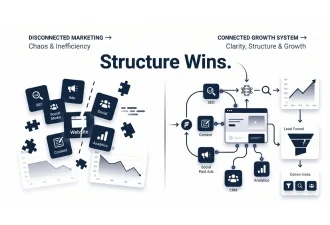
The businesses generating the most consistent, high quality leads in 2026 are not doing any single thing brilliantly. They are doing multiple things in coordination.
Their SEO brings in intent matched organic visitors. Their content builds authority and keeps prospects engaged. Their landing pages convert that engagement into action. Their performance marketing accelerates what is already working organically. And their CRO practice continuously improves every element of the conversion journey.
None of these channels works in isolation. SEO without landing page optimization wastes traffic. Paid ads without funnel strategy wastes budget. Content without distribution stays invisible. The compounding effect only activates when the system works together.
Common Mistakes That Kill Lead Generation
Chasing traffic instead of intent. A thousand visitors with no purchase intent are worth less than fifty who are actively evaluating solutions in your category.
Sending paid traffic to the homepage. This is one of the most common and costly mistakes in B2B digital marketing. Every campaign deserves a dedicated, purpose built landing page.
Ignoring AI search. If your content is not structured for AI generated answers, you are already invisible to a growing segment of B2B buyers in India.
Publishing content without a conversion path. Every piece of content should have a logical next step for the reader, whether that is a related article, a lead magnet, or a service page. Content without a journey is just noise.
Measuring vanity metrics. Sessions, impressions, and follower counts tell you very little about lead generation health. Track form submissions, cost per qualified lead, and pipeline contribution.
Final Thought: Marketing That Earns Its Budget
The best digital marketing strategies in 2026 do not just generate attention. They generate pipeline. They are built around the buyer's journey, optimized for intent, and measured against outcomes that actually matter to the business.
For B2B brands in India, the opportunity right now is significant. Most competitors are still running broad campaigns, publishing generic content, and wondering why their leads are inconsistent. Brands that invest in a properly structured, conversion focused digital system today will build an advantage that compounds for years.
If you are ready to move from activity to outcomes, get in touch with the Futuready team to explore what a lead generation focused strategy could look like for your business.
Commonly asked.
Honestly answered.
The most effective approach combines intent driven SEO, conversion optimized landing pages, and a full funnel performance marketing strategy. No single channel delivers consistent B2B leads in isolation. The businesses generating the best results are those running coordinated systems where SEO, content, paid media, and CRO work together toward a common conversion goal.
Intent driven SEO typically begins showing measurable lead impact within three to six months for competitive categories and as early as six to eight weeks for lower competition, high intent keywords. The key is targeting commercial and transactional queries from the start rather than purely informational content that drives traffic without conversion intent.
Neither is universally better. Paid marketing delivers faster results and precise audience targeting but stops generating leads the moment the budget stops. SEO builds compounding, long term visibility that does not disappear when you pause spending. The most effective B2B lead generation strategies use paid media to accelerate and test what SEO then sustains at scale.
AI tools are reshaping how B2B buyers discover and shortlist vendors. A growing number of decision makers now use AI assistants to research solutions before visiting any website. This means brands must optimize content for AI generated answers through AEO and GEO practices, not just traditional search rankings. Brands that appear in AI search responses gain access to buyers earlier in their decision journey.
Conversion Rate Optimization is the practice of systematically improving the elements of your website and landing pages that influence whether a visitor takes action. Even modest CRO improvements can dramatically increase lead volume without any additional marketing spend. For most B2B websites, the conversion rate gap between current performance and potential is significant, making CRO one of the highest ROI digital marketing investments available.